Cadence vs. Acumen Fuse.
A fair, line-by-line map. Where Cadence matches, where it differs, where Fuse still leads.
Two tools that do different jobs.
This is the comparison people get wrong, so it is worth being precise. Deltek Acumen Fuse is a schedule analytics and quality-diagnostics tool. It reads a schedule, runs the DCMA 14-point assessment, and applies a deep library of intelligence metrics and benchmarks to tell you how good that schedule is. What it does not do is build the schedule. Fuse authors nothing, levels nothing, runs no critical path, and computes no earned value. It sits on top of a schedule built elsewhere, usually in P6.
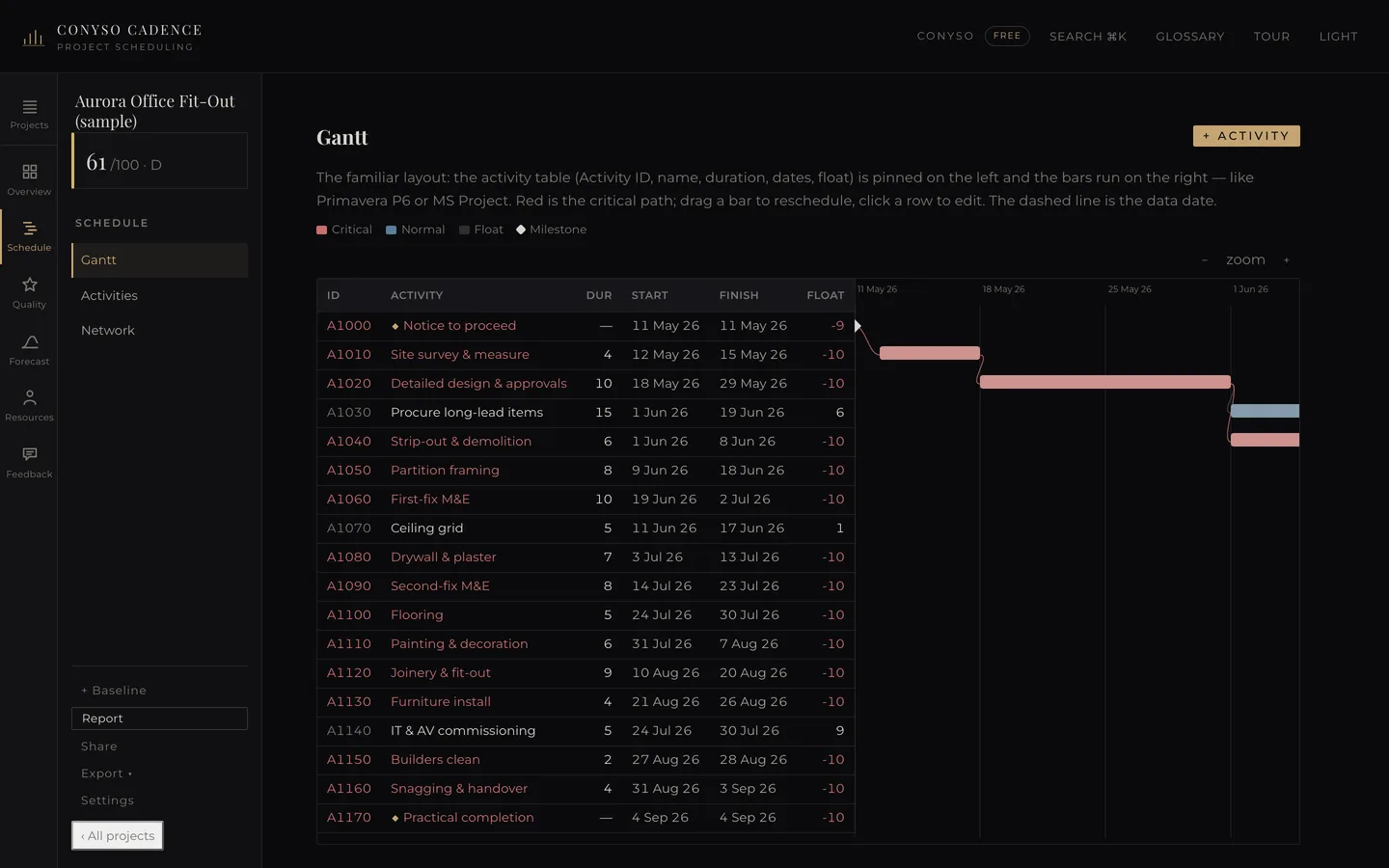
Cadence builds the schedule and audits it in one tool. The honest split is this: Fuse has the deeper, more mature analytics and benchmarking library, with years of standing in claims and forensic practice. Cadence has the DCMA audit built into an actual scheduler that also does CPM authoring, resource leveling, Monte-Carlo risk, earned value, and forensic delay analysis, free and in a browser. The trade-offs are real in both directions. This is the map.
Six differences that aren't about metric depth.
Builds and audits
Cadence authors a CPM schedule and scores it against DCMA in the same tool. Fuse analyzes a schedule it cannot build; you still need P6 or another scheduler underneath it.
Free & open
Free in your browser, against a paid desktop license that runs into thousands of dollars. No seat math, no license server, no Windows-only install.
Browser-native
Any modern browser, or one docker run behind your own firewall. Drop in a .xer and get a 0 to 100 score in seconds, with nothing to install.
Risk & EVM, included
Seeded Monte-Carlo risk and earned value are built in. Around Fuse those live in separate products such as Acumen Risk and the wider Deltek stack.
Plain-English fixes
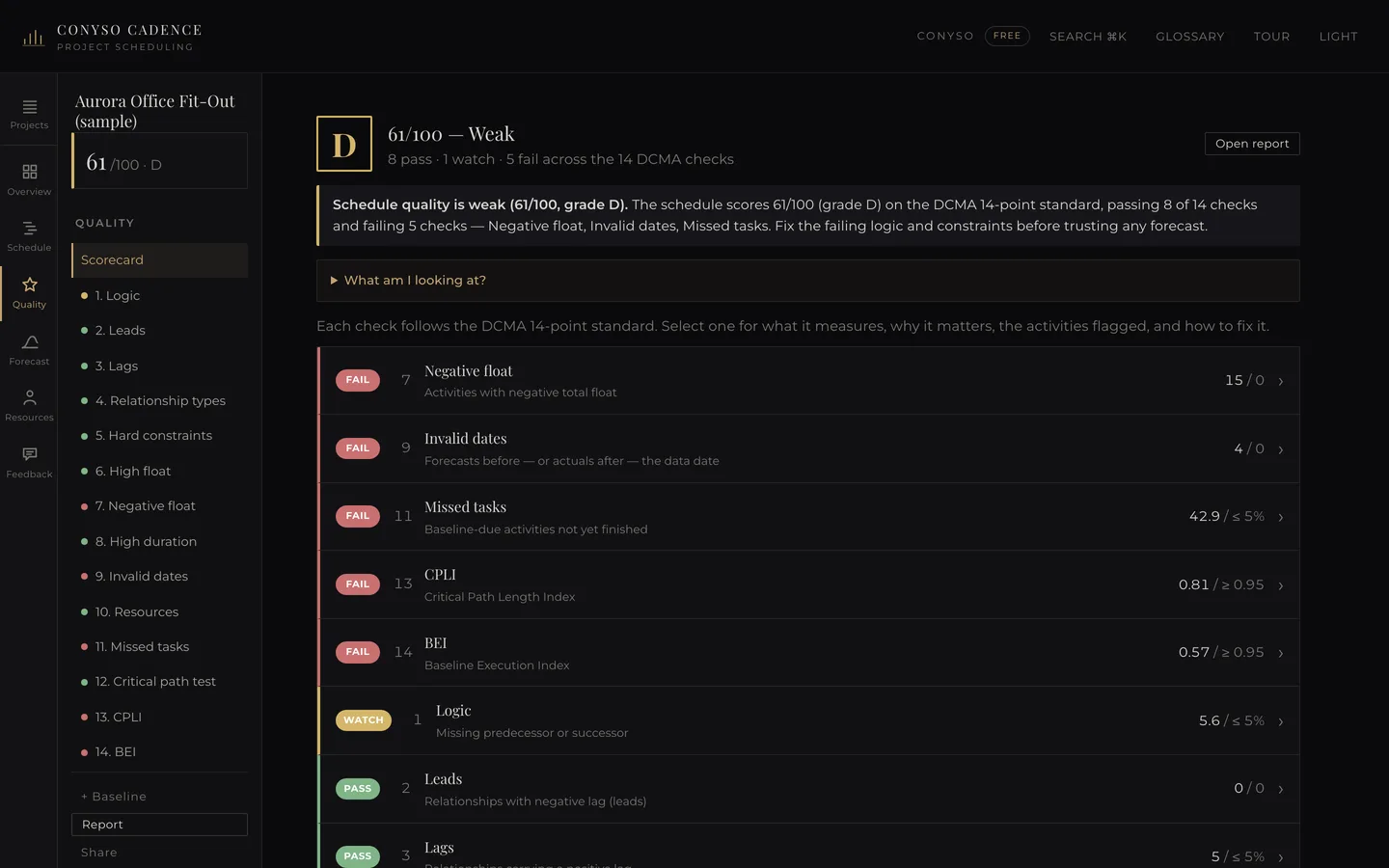
Each DCMA check carries a plain-language verdict and the exact tasks to fix, rule-based from the computed numbers. The findings read like a person wrote them, with no AI in the math.
Open formats & sharing
Reads and writes .xer and MS Project XML, exports open JSON, and mints a read-only share link or a self-contained HTML report a client opens without a license.
What it costs to get started.
Cadence
docker run- Free in your browser, forever
- Self-host with one
docker run, no cost - Self-hostable; your data stays in-house
- Your schedules stay in-house when self-hosted
- No login, no seats, no telemetry
Acumen Fuse
- Windows desktop install
- Paid commercial license, thousands of dollars
- License-locked, account / activation required
- Closed-source
- Part of the wider Deltek Acumen stack
Schedule and analytics, side by side.
| Capability | Cadence | Acumen Fuse |
|---|---|---|
| Cost & access | ||
| Price | FreeFree in the browser, self-hostable, no seats | Paid desktop licenseCommercial, thousands of dollars per seat |
| Platform | Any modern browser | Windows desktop |
| Self-hosting | One docker run |
Desktop install |
| Login / license | None (free & self-hostable) | Commercial, closedActivation / license required |
| What the tool is | ||
| Authors a schedule / CPM | YesFull critical-path engine: four relationship types (FS / SS / FF / SF), lags, constraints, total & free float, cycle detection | NoAnalysis only; reads a schedule built elsewhere, usually P6 |
| Resource leveling | YesLoading curves, time-phased availability, per-activity calendars | No |
| Earned value (SPI / CPI / EAC) | YesPV / EV / AC curves against a baseline | No |
| Schedule risk (Monte-Carlo) | Yes, built inSeeded and reproducible: P10 / 50 / 80 / 90, S-curve, tornado, criticality, cost risk | NoA separate product, Acumen Risk |
| Schedule-quality audit (the overlap) | ||
| DCMA 14-point assessment | YesAll 14 checks, built into the scheduler | YesA core part of what Fuse is built for |
| 0 to 100 score + per-check findings | YesScored 0 to 100, with a finding and the exact tasks per check | YesScored metrics with drill-down to the offending activities |
| Broader analytics / intelligence-metric library & benchmarking | DCMA-focusedA solid DCMA-centered audit, not yet a full Fuse-class analytics suite | DeeperA mature intelligence-metric library (S1 to S-x and beyond) with benchmarking; the deeper of the two |
| Plain-language fix guidance | YesRule-based verdicts and a plain-English read of what to do next, no AI | Metric-ledSurfaces the failing metric and activities; the read is the analyst's |
| Forensic / delay | ||
| TIA / but-for / windows | Built inTime Impact Analysis, collapsed as-built (but-for), and windows, the AACE 29R-03 family | In the Acumen suiteForensic depth lives more in the wider Acumen stack and practice than in Fuse alone |
| Schedule comparison / diff | YesDiff two .xer: finish movement, quality change, slips, scope churn |
YesCompare revisions and benchmark drift over time |
| Openness & sharing | ||
Import .xer |
YesPlus MS Project XML and CSV | Yes |
| Open JSON export | YesPlus CSV and .xer / MS Project XML out; the schedule in a format anything can read |
No |
| Read-only share link | Yes | No |
| Self-contained HTML report | YesOne file the client opens without a license | Export to reportExports reports to common office formats |
| Trust & determinism | ||
| Deterministic / reproducible | YesPure-function engine recomputed on demand; seeded risk, same inputs, same outputs | Deterministic metrics |
| Plain-English read | YesVerdicts, findings, and an executive summary, rule-based from the numbers | Metric annotations |
| No-AI math | YesEvery number is deterministic; nothing a model invented | DeterministicRule-based metric library, not generative |
| Self-hostable | Self-host licenseRuns on your own infrastructure | Closed |
| Automated tests | 43, published | Internal, unpublished |
| Analytics ecosystem (Fuse's home ground) | ||
| Analytics-library depth & benchmarking | DCMA-centered | Deep & matureA broad intelligence-metric library with benchmarking, beyond DCMA |
| Deltek Acumen stack integration | Open formatsIntegrates by reading and writing .xer and XML |
YesTight integration with Acumen Risk, Acumen 360, and P6 workflows |
| Installed base & years | New (2026) | EstablishedYears of installed base and practitioner trust |
| Claims-practice adoption | New entrant | YesAn established place in claims and forensic-scheduling practice |
| Training & certification ecosystem | Community | ExtensiveOfficial training and a partner ecosystem |
Where Fuse still wins.
Fuse has a deeper and more mature schedule-analytics and intelligence-metric library than Cadence's DCMA-centered audit, with benchmarking that goes well past the 14 points. If your job is to diagnose and benchmark schedule quality at the level of a specialist forensic analyst, that depth is its home ground, and Cadence is not yet a full Fuse-class analytics suite.
It also has an established place in claims and forensic practice, tight integration with the wider Deltek Acumen stack (Acumen Risk, Acumen 360) and with P6 workflows, and years of installed base and practitioner trust behind it. Cadence implements the DCMA standard well, but it is new, and honest about that.
Where Cadence wins.
Cadence builds the schedule and audits it in one tool. Fuse can tell you a schedule is weak, but it cannot author it, level it, run the critical path, compute earned value, or model risk. Cadence does all of that, with the DCMA 14-point audit scored 0 to 100 alongside seeded Monte-Carlo risk, earned value, and forensic delay analysis, free and in a browser.
It reads and writes open formats (.xer, MS Project XML, JSON, CSV), mints read-only share links and self-contained HTML reports, and every number is deterministic and reproducible, backed by 43 published tests and source you can read. You can drop in a .xer and get a 0 to 100 score in seconds, without a paid license, an install, or a login.
When to use which.
Use Acumen Fuse when
You want the deepest schedule-analytics and benchmarking library available, you already author in P6, and you live in the Deltek stack. For specialist forensic diagnostics at that depth, Fuse is the mature tool and Cadence does not pretend to match it yet.
Use Cadence when
You want to build, score (DCMA), risk, run EVM on, and delay-analyze a schedule in one free browser tool, or to drop in a .xer and get a 0 to 100 score in seconds without a paid license. Open formats, deterministic, self-hostable.
Use both when
They can coexist. Author and govern in P6, lean on Fuse for the deepest analytics, and bring the same .xer into Cadence to author edits, run risk and EVM, score it against DCMA, or build a delay analysis without a license.
Score a real schedule in ten seconds.
Comparison written by Conyso Labs, 2026. Acumen Fuse is a trademark of Deltek, Inc. This page is not affiliated with or endorsed by Deltek.
Questions, answered.
Is Cadence a free alternative to Acumen Fuse?
For the DCMA 14-point schedule-quality audit, yes, free in your browser, plus it builds the critical-path schedule itself. Acumen Fuse is a mature analytics layer over existing schedules; Cadence both builds the programme and audits it, without a per-seat licence.
Does Cadence run the DCMA 14-point analysis?
Yes. It scores your programme 0 to 100 across all 14 checks with a plain-English verdict per check.
Can I bring a schedule from P6 or MS Project?
Yes. Cadence imports Primavera .xer and MS Project XML, so you can audit an existing plan.
Do I need to install anything?
No. It runs in the browser free; self-host for a one-time licence when data must stay in-house.
When is Acumen Fuse still worth it?
For deep, configurable schedule analytics across a large portfolio. Cadence covers the core DCMA audit and CPM scheduling for free.