FMEA in automotive
In automotive engineering, FMEA is the discipline of naming every way a design or a process could fail and fixing the ones that would hurt the driver before a single part is built.
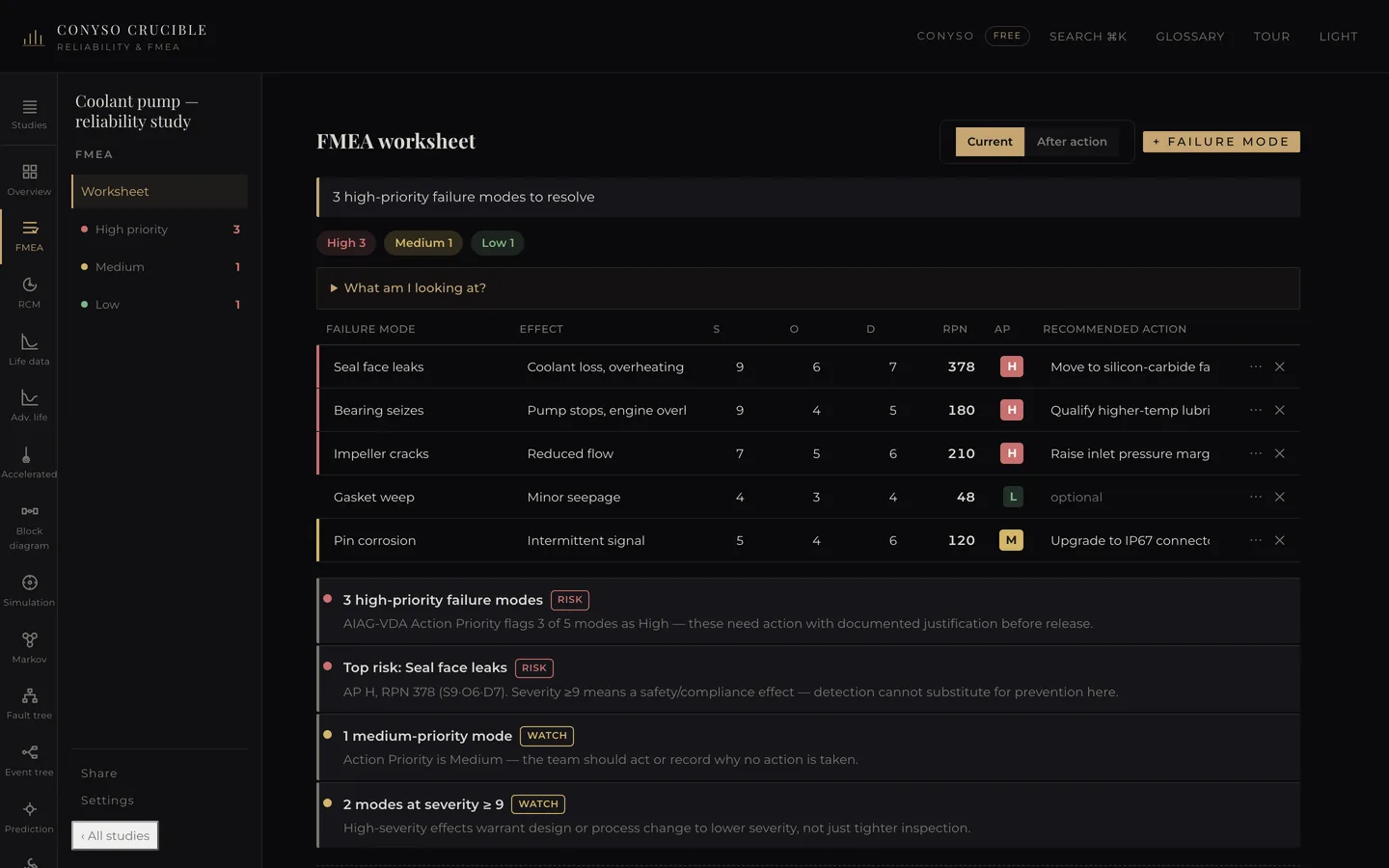
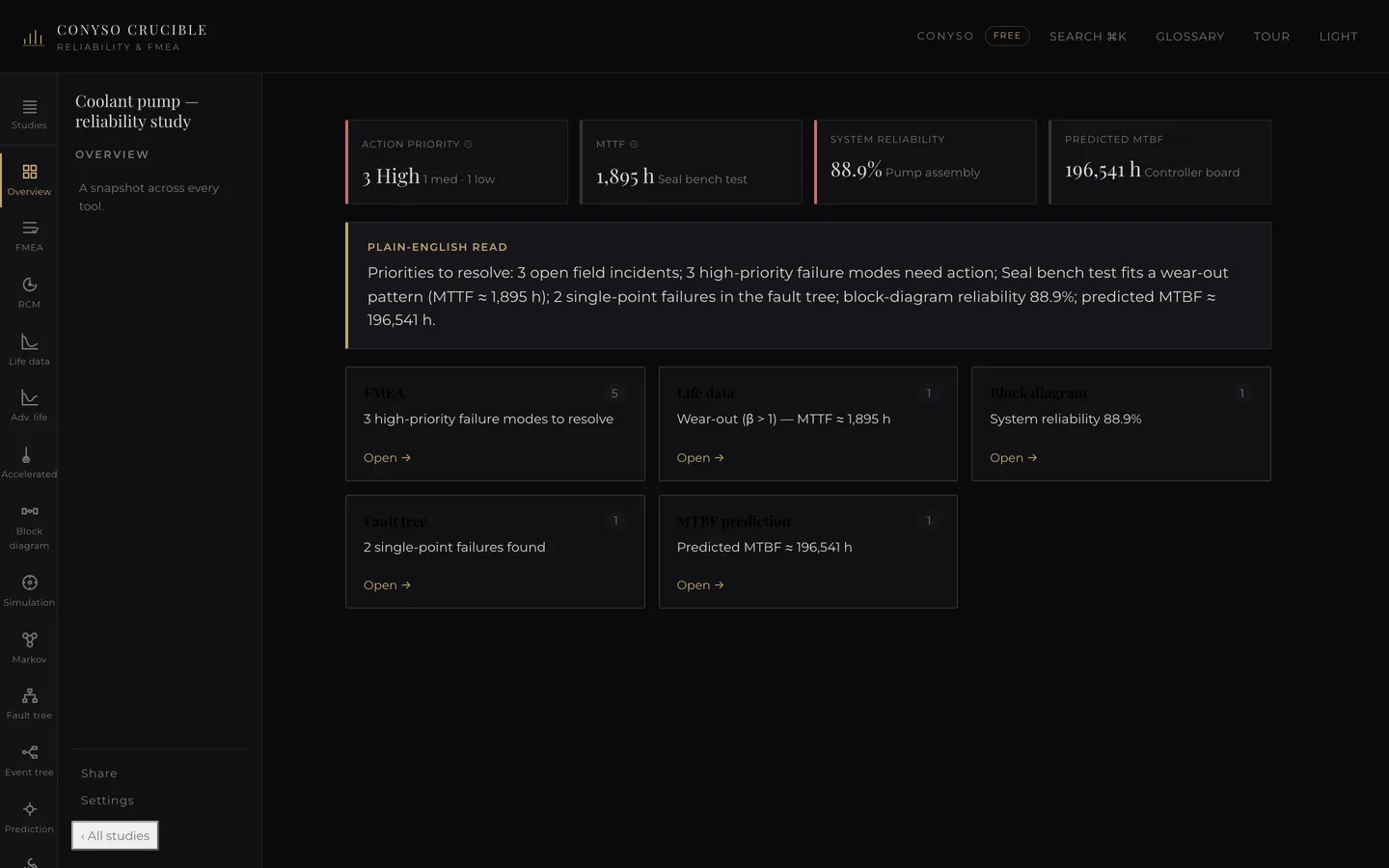
The fit.
Automotive engineering runs on a promise that is almost impossible to keep: that a machine assembled from thousands of parts by thousands of hands, then driven for a decade through heat, cold, road salt, and constant vibration, will not hurt anyone.
A connector that unlatches, a weld that skips, a sensor that drifts a few millivolts a year can each propagate into a stall on a motorway or a brake pedal that feels wrong on a wet exit ramp. The cost of discovering these failures late is measured not only in warranty claims and recall logistics but in a reputation that took decades to build and can be spent in a single news cycle.
FMEA, Failure Mode and Effects Analysis, fits this world because it formalises the question a good engineer already asks at two in the morning: what could go wrong, and what happens to the person in the seat if it does.
The method forces a team to walk every function of a system, name every way that function could fail, trace each failure through to its effect on the driver and the vehicle, and then rank the combination by how severe the effect is, how often the cause occurs, and how likely current controls are to catch it. In automotive practice the work splits cleanly into DFMEA, which interrogates the design intent itself, and PFMEA, which interrogates the manufacturing and assembly process that turns that intent into real parts on a real line.
What FMEA changes is less about paperwork and more about when knowledge arrives. Without it, a program learns about a marginal seal, an ambiguous torque spec, or a sensor mounting that traps condensation from a warranty spike two model years after launch, when tooling is cut and the fix is a service campaign.
FMEA moves that learning to the design review, where a heater core routing can still be changed, a poka-yoke can still be added to a fixture, or a diagnostic threshold can still be tuned in software. It reframes the engineer from someone who validates a finished design to someone who is accountable for having imagined the failure before the customer did.
The 2019 harmonisation of the AIAG and VDA handbooks reshaped how the industry runs the analysis. The old single risk priority number, the product of severity, occurrence, and detection, was retired in favour of Action Priority, which sorts every line into High, Medium, or Low based on defensible logic rather than a multiplied score that treated a ten-times-two-times-five the same as a two-times-five-times-ten.
The seven-step approach that came with it puts structure before scoring: define the scope, build a structure analysis, map functions, then failures, then risk, then optimisation, then documentation. Done honestly it is slow, and that slowness is the point. A DFMEA rushed to close a gate is a liability with a signature on it.
The payoff is cumulative. A supplier that runs disciplined PFMEA carries a living record of every way its process can produce a nonconforming part and every control that stands in the way, which becomes the backbone of the control plan, the PPAP submission, and the response when a customer plant reports a defect.
The design house that runs disciplined DFMEA builds an institutional memory of failure that outlives the engineers who wrote it, so the next platform does not rediscover the same connector problem from scratch. FMEA is not a form. It is the mechanism by which an organisation refuses to be surprised twice.
In practice.
Interface and connector risk
Wiring harness DFMEA concentrates on the connections that field data punishes most: unlatched connectors, terminal fretting under vibration, and pin-to-pin shorts, each traced to loss of a specific vehicle function.
Sensor and actuator drift
For chassis and powertrain sensors the analysis weighs slow degradation and out-of-range failure separately, because a stuck-plausible signal that the diagnostic cannot see is far more dangerous than an obvious open circuit.
Process poka-yoke on the line
PFMEA turns high occurrence causes into physical error-proofing: asymmetric fixtures that reject a mirrored part, torque tools that will not release until spec is met, and vision checks that gate the next station.
Safety and regulated functions
Braking, steering, restraint, and any function tied to safety goals inherit the highest severity ratings, which under Action Priority forces them into review regardless of how rare or how detectable the failure is.
Software and diagnostic coverage
Detection ratings for electronic systems hinge on whether on-board diagnostics can actually observe the fault and set a code, so DFMEA and the diagnostic strategy have to be written against each other.
Linking FMEA to the control plan
Every PFMEA control that survives review should appear in the control plan with a real reaction plan, so the analysis governs what operators do when a check fails rather than sitting in a binder.
Consider a team developing an electric coolant pump for a battery thermal loop. In the DFMEA, one function is stated plainly: circulate coolant at commanded flow across the operating temperature range. The team lists failure modes against it, and one reads low flow at cold start. The effect chain is followed all the way out: reduced heat transfer from the pack, slower conditioning, and in a worst case a derated charge rate that the driver experiences as a car that will not fast-charge on a cold morning.
Severity is high because it touches a headline customer function. The cause is traced to increased bearing drag from grease that stiffens below a threshold, and current design controls are a supplier datasheet and a single cold bench test. Detection is judged weak, because the test point does not represent the coldest real duty cycle.
That single line drives concrete change. The team specifies a low-temperature grease, adds a cold-soak flow verification to the design validation plan, and hands the PFMEA team a note that grease fill volume is now a special characteristic.
On the line, the PFMEA identifies overfill and underfill as causes of a related flow failure, so the fill station gets a weigh-scale interlock that will not pass a pump outside a mass window, and the control plan gains a reaction plan that quarantines a full tote if three consecutive parts drift. None of this required a field failure to happen first. It required a team willing to say out loud, before the design was frozen, exactly how the pump could betray the person depending on it.
Common mistakes.
The most common failure of automotive FMEA is that it becomes a compliance ritual performed to pass a gate rather than a genuine hunt for weakness. When severity, occurrence, and detection numbers are copied from a similar past program without argument, or when Action Priority is quietly overridden so a difficult line does not require action before launch, the document still looks complete and audits still pass, but the analysis has stopped protecting anyone.
A related trap is the carryover assumption: a part reused from a previous platform is marked as proven, yet the new duty cycle, the new thermal environment, or a new adjacent component can revive a failure mode the original team never faced.
The second industry-specific hazard is the gap between DFMEA and PFMEA ownership. Design engineers write the DFMEA, manufacturing writes the PFMEA, and a special characteristic that the design team flagged as critical fails to survive the handoff into the control plan, so the line never knows it is guarding something that matters.
FMEA only works when the two documents and the control plan are treated as one connected chain, reviewed together, and updated whenever a field return, a warranty pattern, or an eight-discipline problem report reveals a failure mode the team did not imagine the first time.
Common questions.
What is the difference between DFMEA and PFMEA in automotive?
DFMEA examines the design itself, asking how a system or component could fail to perform its intended function. PFMEA examines the manufacturing and assembly process, asking how the process could produce a part that does not match the design. A program needs both, and the special characteristics identified in the DFMEA should flow into the PFMEA and the control plan.
Why did the industry move from RPN to Action Priority?
A risk priority number multiplied severity, occurrence, and detection, which meant very different risk profiles could produce the same score and get the same attention. The 2019 AIAG and VDA harmonisation replaced it with Action Priority, which sorts each failure into High, Medium, or Low using logic that respects severity first, so a dangerous failure is never buried by a low occurrence rating.
When should an automotive FMEA be started?
As early as the design concept allows, well before the design is frozen. The value of FMEA comes from acting while a routing, a tolerance, or a fixture can still be changed cheaply. Starting late turns the exercise into documentation of decisions that can no longer be reversed.
Who should be in the room for an FMEA?
A cross-functional team, not a single engineer. Effective sessions include design, manufacturing, quality, validation, and often the supplier, because the person who understands the failure cause is frequently not the person who understands the effect on the vehicle or the customer.
How does FMEA connect to the control plan?
Every process control that survives the PFMEA should appear in the control plan along with a reaction plan that tells operators what to do when a check fails. If a control lives in the FMEA but never reaches the control plan, the analysis has identified a risk that the line is not actually guarding against.
Is an FMEA ever finished?
No. It is a living document. Field returns, warranty patterns, and problem reports regularly surface failure modes the original team did not imagine, and each one should be fed back into the FMEA so the next program inherits the lesson instead of relearning it.
FMEA · Action priority · All applications → · The resource center →
See this from every format.
Crucible is deterministic reliability engineering: FMEA, Weibull life-data, reliability block diagrams, fault trees and MTBF prediction.