FMEA vs FMECA
FMEA and FMECA are the same core analysis, except FMECA adds a formal criticality step that ranks failure modes by how serious and likely they are.
FMEA vs FMECA, at a glance.
| FMEA | FMECA | |
|---|---|---|
| Full name | Failure mode and effects analysis | Failure mode, effects and criticality analysis |
| Core activity | Identify failure modes and effects | Same, plus rank criticality |
| Criticality analysis | Not formally included | Formally included |
| Typical output | Failure modes with mitigations | Failure modes ranked by criticality |
| Rigor and effort | Lower | Higher |
| Common context | Broad quality and design use | Safety critical, defence, aerospace |
The real distinction.
FMEA and FMECA are the same method up to a point, and the difference is the single extra letter. FMEA, failure mode and effects analysis, systematically identifies the ways a product or process can fail, traces the effect of each failure mode, and drives mitigations to reduce risk.
FMECA, failure mode, effects and criticality analysis, does everything an FMEA does and then adds a criticality analysis, a formal step that ranks each failure mode by the severity of its effect and the likelihood of its occurrence, so the most critical items rise to the top in a defensible, documented way.
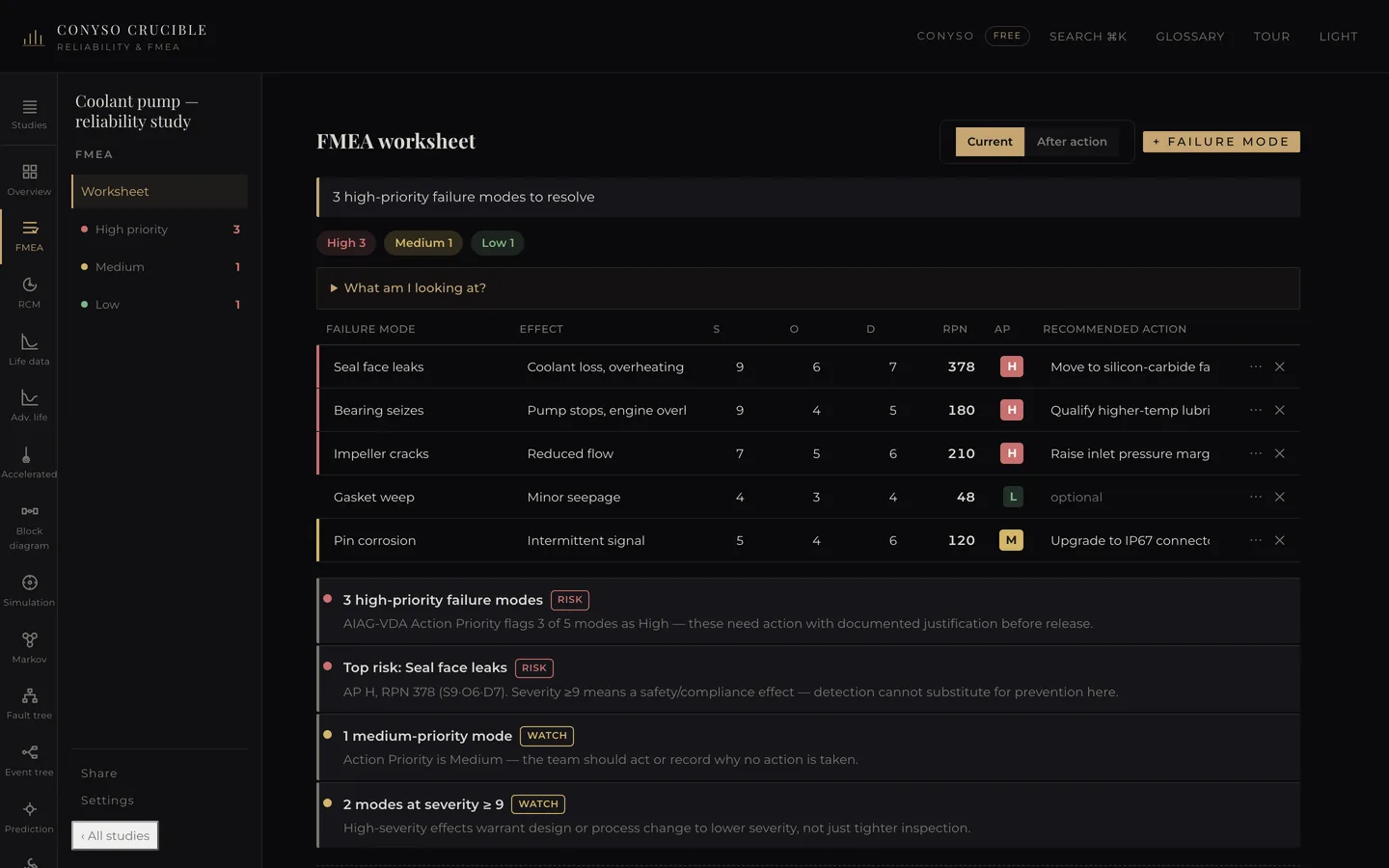
The extra step changes the character of the study. A plain FMEA might list a valve failure mode, describe that it causes loss of pressure, and record a corrective action, relying on the team's judgement to prioritise. A FMECA takes the same valve failure mode and assigns it a criticality based on how severe the loss of pressure is and how probable the failure is, often producing a criticality number or matrix that lets you compare it objectively against every other failure mode in the system. That ranking is the value FMECA adds.
Because of the added rigor, FMECA is common in aerospace, defence, and other safety critical fields where standards or contracts require a demonstrable basis for prioritisation. FMEA, being lighter, is used far more broadly across design and process quality where identifying and mitigating failure modes is the main goal and a full criticality analysis would add cost without changing the decisions. Neither is a different tool; FMECA is simply an FMEA with a criticality analysis bolted on.
Choosing between them.
Use FMEA when
Use FMEA when the goal is to find failure modes, understand their effects, and put mitigations in place, and when team judgement is an acceptable basis for prioritising the work. It suits most design and process improvement, is quicker to complete, and delivers most of the risk reduction benefit. Choose it when a formal, numeric criticality ranking would add effort without changing which actions you take.
Use FMECA when
Use FMECA when you need a formal, ranked assessment of which failure modes are most critical, especially where a standard, regulator, or customer contract requires it, as is common in aerospace, defence, and medical systems. Choose it when severity and likelihood must be documented and compared objectively across the whole system, so that resources go to the genuinely most critical failure modes rather than the ones that felt worst.
Common mistakes.
A frequent mistake is calling a study a FMECA when no real criticality analysis was performed, so the extra rigor is claimed but not delivered. The opposite error is running a heavyweight FMECA where a FMEA would have sufficed, spending effort on criticality scoring that does not change the mitigation decisions. Both methods also fail when treated as a one time paperwork exercise rather than a living analysis updated as the design, process, or field data evolve.
Common questions.
What does the extra C in FMECA stand for?
Criticality. FMECA is a FMEA plus a criticality analysis that ranks each failure mode by the severity of its effect and its likelihood of occurring.
Is FMECA better than FMEA?
Not universally. FMECA adds rigor through criticality ranking, which is valuable for safety critical work, but for many projects a FMEA delivers most of the benefit at lower cost.
When is FMECA required?
It is often required in aerospace, defence, and other regulated or contractual settings where a documented, objective ranking of critical failure modes must be demonstrated.
Can I add criticality to an existing FMEA?
Yes. Because FMECA is an FMEA with a criticality analysis added, you can extend a completed FMEA by scoring severity and likelihood to produce the criticality ranking.
Does FMEA use RPN instead of criticality?
Many FMEAs prioritise with a risk priority number or action priority, while FMECA uses a formal criticality analysis. The two approaches to ranking differ in method and rigor.
Are FMEA and FMECA one time activities?
No. Both should be living documents, updated as the design, process, and field experience change, so the analysis keeps reflecting the real risks.
See this from every format.
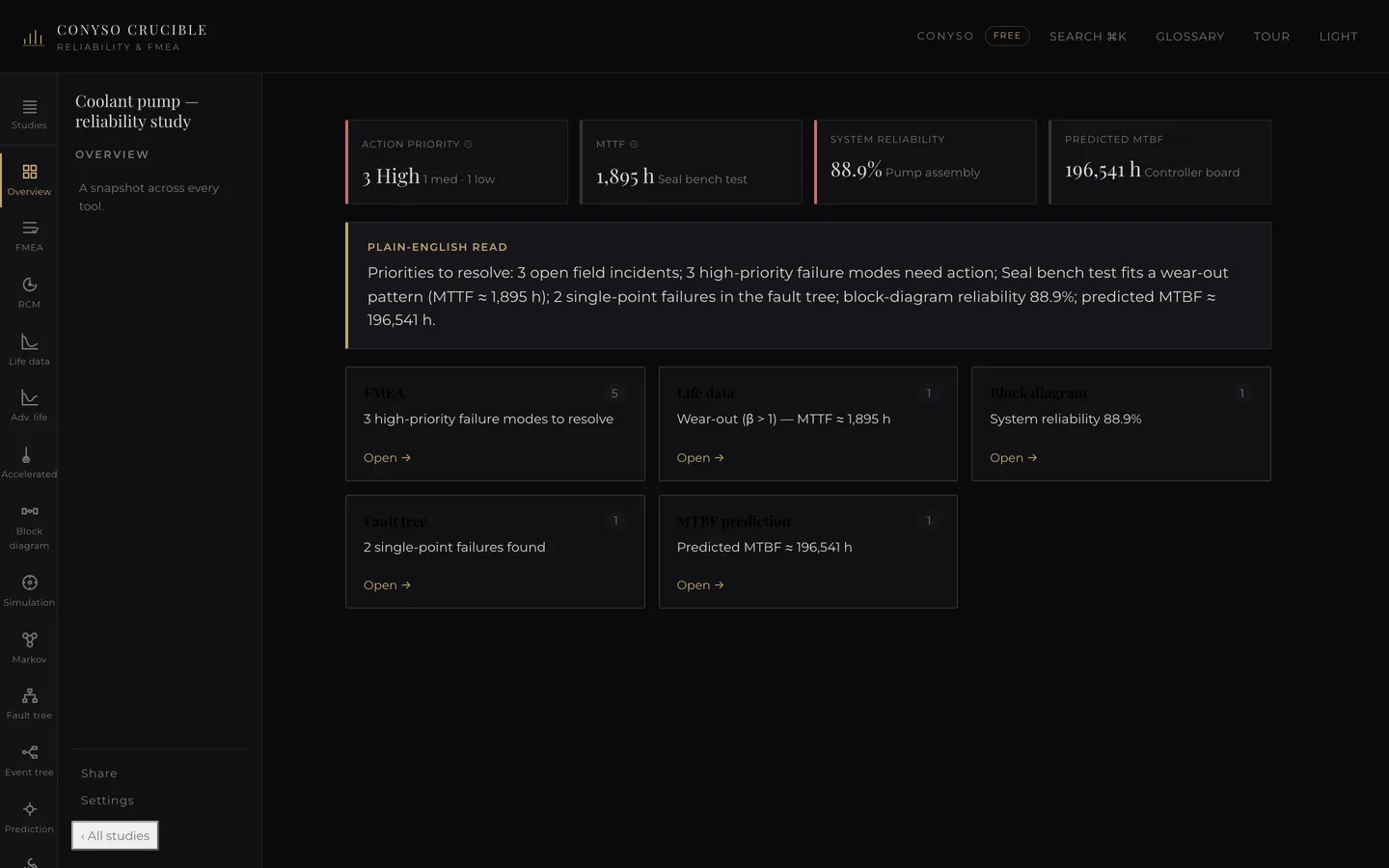
Crucible is deterministic reliability engineering: FMEA, Weibull life-data, reliability block diagrams, fault trees and MTBF prediction.