The Baader–Meinhof Phenomenon
also known as — The frequency illusion
"Once you notice something, you start seeing it everywhere."
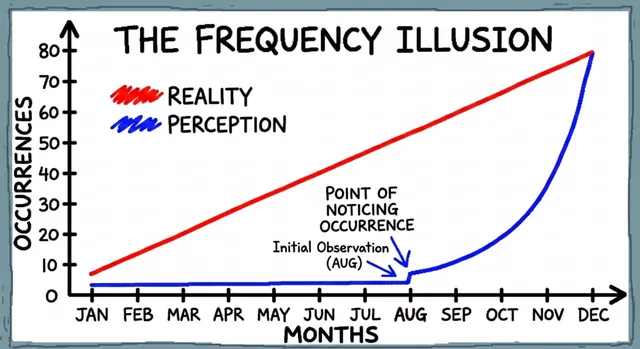
You learn a new word, settle on a car model, or hear an unusual name, and suddenly it seems to be everywhere. Nothing in the world changed. Your attention started registering instances it used to filter out, and you mistook that shift in noticing for a shift in reality.
Rated Heuristic: a dependable rule of thumb, not a proven theorem. The other 224.
Two cognitive processes work together. Selective attention: once something is flagged as relevant, the brain unconsciously filters for it and registers instances it previously ignored. Confirmation bias: each new sighting is taken as evidence that the thing really has become more common, while the absences that would disprove it go uncounted. The underlying base rate never moved, only detection and interpretation did.
Also coined by Arnold Zwicky: the belief that something you have only recently noticed is itself new to the world, when it may be long-established (a sibling illusion about time rather than frequency).
Not variants so much as the two component mechanisms: the attentional filter that does the noticing and the interpretive bias that 'confirms' the pattern.
It is a clean, everyday demonstration that perceived frequency is a product of attention, not a reliable readout of the world. Recognising it inoculates against a common reasoning error: treating 'I keep seeing this' as evidence that something is actually spreading, when only your alertness has changed.
It is a perceptual and cognitive illusion, not a real change in frequency. That is its defining caveat. Much of the supporting evidence is anecdotal and self-reported, and the effect is inherently hard to measure because you cannot easily quantify what a person failed to notice before. The construct originates in linguistics blogging (2005) and lexicography rather than a controlled psychology experiment, and rigorous experimental isolation of the named effect is limited: adjacent work exists on attention and frequency estimation, but no single definitive demonstration is well established.
It is not a claim that things really do cluster once you notice them, nor a mystical synchronicity: the base rate is unchanged and only attention has shifted. It is also more lightly studied than its fame suggests: a well-described heuristic grounded in known biases, not a heavily replicated experimental effect.
Real as a rule of thumb, not as a theorem. The Baader–Meinhof Phenomenon is rated Heuristic here: dependable enough to plan with, and with no proof behind it.
Rated from three sources. 225 of the 1,116 entries carry this rating. How the scale works.
The best-known laws are the least likely to rest on measurement.
The term 'frequency illusion' was coined by the Stanford linguist Arnold Zwicky in an August 2005 Language Log post. The nickname 'Baader–Meinhof phenomenon' comes from a 1994 reader submission to the St. Paul Pioneer Press, from a writer who had heard the name of the West German militant group twice in quick succession. The Oxford English Dictionary added 'frequency illusion' in its March 2019 update.
Everything above traces to en.wikipedia.org, languagelog.ldc.upenn.edu and science.howstuffworks.com: three secondary sources, accounts of the original rather than the original itself, which has not been located for this entry. Nothing is written from memory, and the method is written down. Spot an error or a better source? Suggest a fix.
