Boyle's Law
also known as — Mariotte's law, The Boyle–Mariotte law
"At constant temperature, a gas's pressure rises as its volume falls."
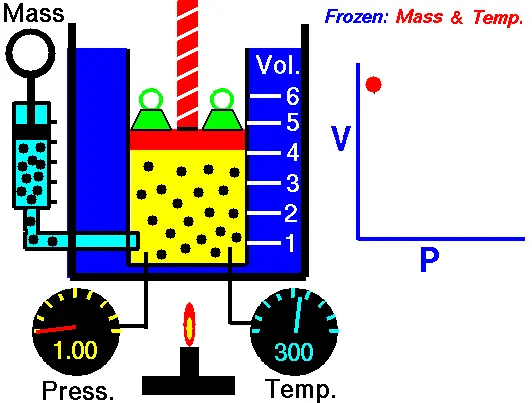
Squeeze a fixed amount of gas into half the space, at unchanged temperature, and its pressure doubles; let it expand to twice the volume and the pressure halves. Pressure and volume trade off so that their product stays constant.

P \propto \frac{1}{V}Rated Empirical: grounded in studies or measurable evidence. The other 608.
Gas pressure comes from molecules striking the container walls. Shrink the volume and the same molecules are packed into a smaller space, so they hit the walls more often per unit area and the pressure rises. Because temperature is held constant, molecular speed does not change. It is the collision frequency, not harder hits, that varies.
The same law under its continental European name, after Edme Mariotte, who found it independently around 1679 and added that it holds at constant temperature.
Boyle's law is the constant-temperature, fixed-amount slice of PV = nRT, the unified relation that also contains Charles's, Gay-Lussac's, and Avogadro's laws.
It was among the first quantitative laws of gas behaviour and a founding result of physical chemistry, the pressure-volume relationship that underlies everything from syringes and lungs to the design of pressure vessels. It is also a clean component of the ideal gas law, into which it and its sibling laws assemble.
Boyle's law holds only for an ideal gas, at constant temperature and fixed amount. Real gases deviate, especially at high pressure and low temperature, where molecular volume and intermolecular attractions matter: deviations described by the van der Waals equation and the compressibility factor. It is an accurate approximation within its regime and a limiting-case idealisation outside it.
It is not an exact universal law but an ideal-gas approximation, and it says nothing when temperature or the amount of gas changes. The attribution is also shared: Richard Towneley and Henry Power noted the pressure-volume relationship just before Boyle confirmed it, and Mariotte found it independently, so 'Boyle's law' honours a contributor rather than a sole discoverer.
Yes, as far as the evidence goes. Boyle's Law is rated Empirical here: it rests on studies or measurements rather than on a saying.
Rated from two sources. 609 of the 1,116 entries carry this rating. How the scale works.
The best-known laws are the least likely to rest on measurement.
Published by the Anglo-Irish natural philosopher Robert Boyle in 1662, in a defence of his air-pump work, after Richard Towneley and Henry Power had noted the relationship (the 'Towneley hypothesis') and with experimental help from Robert Hooke. Edme Mariotte found it independently around 1679, hence 'Mariotte's law' in much of Europe.
10 languages, as recorded on Wikidata. These are names the idea already goes by, not translations we made. The whole index by language.
Everything above traces to en.wikipedia.org and newworldencyclopedia.org: two secondary sources, accounts of the original rather than the original itself, which has not been located for this entry. Nothing is written from memory, and the method is written down. Spot an error or a better source? Suggest a fix.
