Vol. I a living index of named laws · est. mmxxvi no ads · no tracking
The Law Tomeindex of named laws

The Central Limit Theorem

"Add up many independent random quantities and their total tends to a bell curve."
In plain English

What does The Central Limit Theorem mean?

Whenever an observed quantity is effectively the sum or average of many small, independent, comparable random contributions (with no single one dominating) the aggregate tends toward a normal, bell-shaped distribution, whatever the shape of the individual pieces. It is why the bell curve turns up so often in nature and measurement.

Run the numbers

The Central Limit Theorem calculator

The mean of a sample gets precise as the square root of n, which is why the fourth decimal costs a hundred times the first.

SE = sigma / sqrt(n)

sigma
Population standard deviation
n
Sample size
Standard error of the mean —
95% margin of error —
Sample needed to halve that —

Computed live from SE = sigma / sqrt(n) — the law's own arithmetic, nothing fitted or predicted.

Reliability

Rated Empirical: grounded in studies or measurable evidence. The other 608.

How it works

How does The Central Limit Theorem work?

Independent fluctuations add: their means add, their variances add, and dividing by the square root of the count keeps the spread stable while symmetric cancellation smooths the shape into a bell. The classical form needs the pieces to be independent, identically distributed, and to have finite variance; as the count grows, the standardised sum approaches the standard normal distribution.
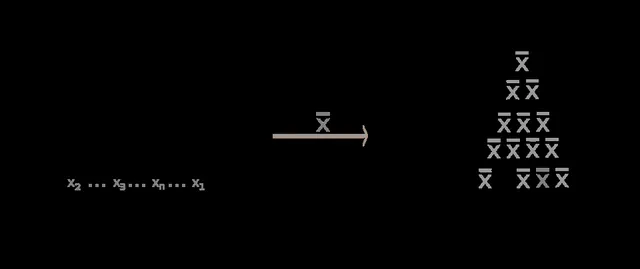
Figure illustrating The Central Limit Theorem
The Central Limit Theorem — Mathieu ROUAUD · CC BY-SA 4.0 · source
Where you'll see it

What are examples of The Central Limit Theorem?

Measurement error and height A measurement error is the sum of many tiny independent perturbations, so it tends to be normal; adult heights, shaped by many additive genetic and environmental factors, are approximately normal too.
Averaging dice A single die is flat and uniform, but the average of many rolls is bell-shaped and near-normal: a classic demonstration that the theorem is about the aggregate, not the individual roll.
Poll margins A poll's sample proportion is an average of independent yes-or-no responses, so its sampling distribution is approximately normal, which is why margins of error are computed with normal-based intervals.
Types & variants

What are the types of The Central Limit Theorem?

The law of large numbers§

A distinct theorem often confused with it: the law of large numbers says where the sample mean goes (it converges to the true mean), while the central limit theorem describes the Gaussian shape of the fluctuations around it.

The generalised central limit theorem§

For heavy-tailed variables with infinite variance, normalised sums converge not to the normal but to stable distributions with power-law tails: the normal is only the finite-variance case.

Why it matters

Why does The Central Limit Theorem matter?

It explains the ubiquity of the normal distribution and underwrites vast swathes of statistics: confidence intervals, significance tests, and error analysis all lean on it. It is the reason averages of messy data behave so predictably even when the data themselves do not.

Working with it

How do you apply The Central Limit Theorem?

  • Expect averages to be normal, not the data — apply it to the sum or mean of many pieces; individual observations from a skewed population stay skewed.
  • Check for finite variance — the classical theorem needs finite variance and independence, so verify those before assuming a bell curve.
  • Beware fat tails — for heavy-tailed data like some financial returns, the normal approximation can fail badly and underestimate extremes.
Where it breaks down

What are the limits of The Central Limit Theorem?

The classical theorem requires finite variance and, in its basic form, independence: the load-bearing assumptions. It fails for heavy-tailed distributions with infinite variance, such as the Cauchy or steep power laws, whose sample means never settle into a normal shape; this is the heart of the fat-tails critique of applying Gaussian methods to real-world risk. Convergence can also be slow or biased for highly skewed or discrete data, so the normal approximation may be poor at realistic sample sizes. It is a proven theorem whose real-world use depends on checking its conditions.

What it doesn't say

What are common misconceptions about The Central Limit Theorem?

It does not say individual data are normal, only that their sums or averages tend to be. Nor is it universal: it needs finite variance, and heavy-tailed distributions break it. And it is not the law of large numbers, which locates the mean rather than describing the spread of fluctuations around it.

Is it real?

Is The Central Limit Theorem real?

Yes, as far as the evidence goes. The Central Limit Theorem is rated Empirical here: it rests on studies or measurements rather than on a saying.

Rated from two sources. 609 of the 1,116 entries carry this rating. How the scale works.

Very widely printedin printed books: one of 22 names in its band, of 903 measured
35 of 49entries in statistics & probability carry the same rating

The best-known laws are the least likely to rest on measurement.

Origin

Where did The Central Limit Theorem come from?

Developed over two centuries: Abraham de Moivre found the binomial special case in 1733, Laplace generalised it toward 1812, Aleksandr Lyapunov gave the first rigorous general proof in 1901, and the name 'central limit theorem' was popularised by George Pólya around 1920.

How the name spread

When did people start saying “The Central Limit Theorem”?

18002019
How often “Central Limit Theorem” appears in printed English, which takes hold around 1954 and peaks around 2014. This tracks the phrase and not the idea. A law is usually older than the name for it. Source: Google Books Ngrams.
Known elsewhere as

What is The Central Limit Theorem called in other languages?

  • Arabicمبرهنة النهاية المركزية
  • Germanzentraler Grenzwertsatz
  • Spanishteorema del límite central
  • Frenchthéorème central limite
  • ItalianTeoremi centrali del limite
  • Japanese中心極限定理
  • Portugueseteorema do limite central
  • RussianЦентральная предельная теорема
  • Chinese中心极限定理

9 languages, as recorded on Wikidata. These are names the idea already goes by, not translations we made. The whole index by language.

Sources

Sources & further reading

  1. 1Central limit theorem, Wikipedia. — the statement, the finite-variance conditions, the Lindeberg/Lyapunov forms, and the heavy-tailed generalisation.secondary
  2. 2Cook, J.D. "How the central limit theorem began." — the de Moivre, Laplace, and Lyapunov history.secondary

Everything above traces to en.wikipedia.org and johndcook.com: two secondary sources, accounts of the original rather than the original itself, which has not been located for this entry. Nothing is written from memory, and the method is written down. Spot an error or a better source? Suggest a fix.

What we checked

  • 1,116entries in the tomeListed one by one on the browse page.
  • 1,116of them citing a sourceOpen any entry: its sources sit at the foot of the page.
  • 2,489source references in allEach is named, and linked wherever the source is online.