Duverger's Law
"Winner-take-all elections tend to produce two dominant parties."
Elections held under single-member-district plurality rules (first past the post, where each district elects one winner and the candidate with the most votes wins outright) tend to produce and sustain a two-party system. Proportional representation, by contrast, which allocates seats in proportion to votes, tends to produce multiparty systems. Duverger framed only the plurality-to-two-party half as a firm 'law' and treated the proportional half as a weaker hypothesis.
Rated Empirical: grounded in studies or measurable evidence. The other 608.
Two effects, both flowing from the winner-take-all rule. The mechanical effect is that translating votes into seats under plurality systematically punishes small parties whose support is spread thinly across districts: a party can win a tenth of the national vote yet almost no seats, because it comes first almost nowhere. The psychological effect is that voters, anticipating this, abandon non-viable third candidates to avoid wasting their vote, concentrating support on the two front-runners. The mechanical effect acts on results; the psychological effect acts on behaviour beforehand, and the two reinforce each other.
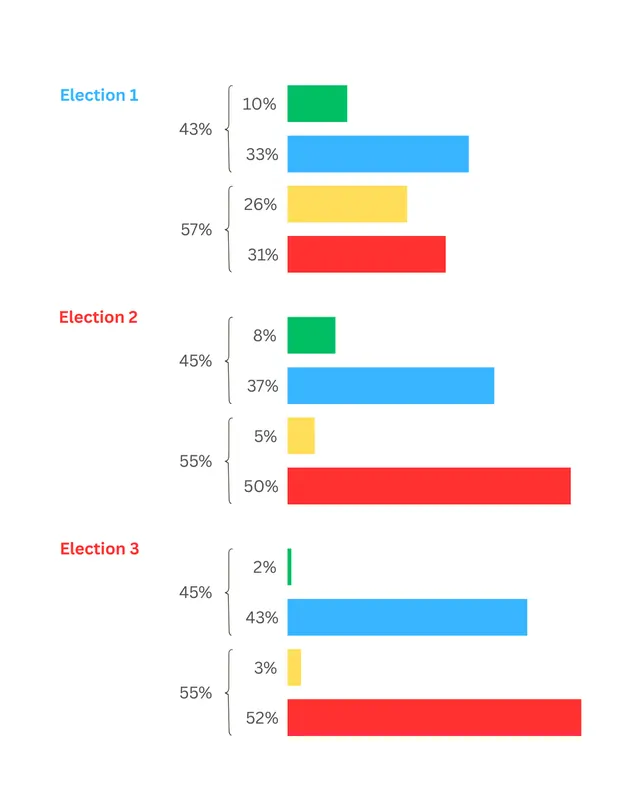
The weaker companion claim that proportional representation and two-round runoff systems favour multipartism, which Duverger held with less confidence than the plurality law.
Gary Cox's generalisation that the number of viable candidates in a district is bounded by the district magnitude plus one, so single-member districts yield two: Duverger's law as a special case.
It is one of the most robustly documented regularities in comparative politics, linking a country's electoral rules to the shape of its party system. It explains why some democracies settle into two-party competition while others sustain many parties, and it underlies debates over electoral reform and the fate of third parties.
It is a strong tendency, not an iron law, and its near-lawlike form holds best at the district level, where competition narrows to two serious contenders. At the national level it has well-known exceptions driven by regional party concentration: Canada, the United Kingdom, and India all sustain significant third and regional parties under first past the post. The strongest defence is that the two front-runners differ by region, so many parties survive nationally even as each district narrows to two. Critics have argued that outside the United States, plurality shows only a weak pull toward two-party politics.
It does not guarantee exactly two parties everywhere plurality is used: third parties with concentrated regional support routinely survive, and the law operates most cleanly district by district. And the proportional-to-multiparty half is a hypothesis Duverger held more loosely, not part of the firm law.
Yes, as far as the evidence goes. Duverger's Law is rated Empirical here: it rests on studies or measurements rather than on a saying.
Rated from two sources. 609 of the 1,116 entries carry this rating. How the scale works.
The best-known laws are the least likely to rest on measurement.
Developed by the French political scientist Maurice Duverger, made central in his 1951 book Les partis politiques (translated as Political Parties, 1954); the label 'Duverger's law' was established by William Riker in a 1982 essay, and the plurality-to-two-party link had been anticipated by Henry Richmond Droop in the nineteenth century.
8 languages, as recorded on Wikidata. These are names the idea already goes by, not translations we made. The whole index by language.
Everything above traces to en.wikipedia.org and ideas.repec.org, two sources in all, one of them the original publication rather than an account of it. Nothing is written from memory, and the method is written down. Spot an error or a better source? Suggest a fix.
