Vol. I a living index of named laws · est. mmxxvi no ads · no tracking
The Law Tomeindex of named laws

Gay-Lussac's Law

also known as — Amontons's law, The pressure law
"At constant volume, a gas's pressure rises in proportion to its absolute temperature."
In plain English

What does Gay-Lussac's Law mean?

Heat a gas trapped in a rigid, sealed container and its pressure climbs in lockstep with temperature: double the absolute temperature and the pressure doubles. Because the volume cannot change, all the added molecular energy shows up as increased pressure.

In symbols

What is the formula for Gay-Lussac's Law?

p \propto T
The defining formula as recorded on Wikidata. p \propto T
Run the numbers

Gay-Lussac's Law calculator

A sealed container heated is a container under rising pressure, which is why aerosol cans carry a temperature warning.

P1 / T1 = P2 / T2 (T in kelvin)

P1
Starting pressure kPa
T1
Starting temperature degC
T2
Final temperature degC
Final pressure —
Change in pressure —

Computed live from P1 / T1 = P2 / T2 (T in kelvin) — the law's own arithmetic, nothing fitted or predicted.

Reliability

Rated Empirical: grounded in studies or measurable evidence. The other 608.

How it works

How does Gay-Lussac's Law work?

In a rigid container, raising the temperature makes molecules move faster, so they strike the walls both more often and with greater force. Pressure is the force per unit area of those collisions, and with the volume fixed there is no room to expand and relieve it, so the pressure rises. The relationship is linear only against absolute temperature, measured from absolute zero.
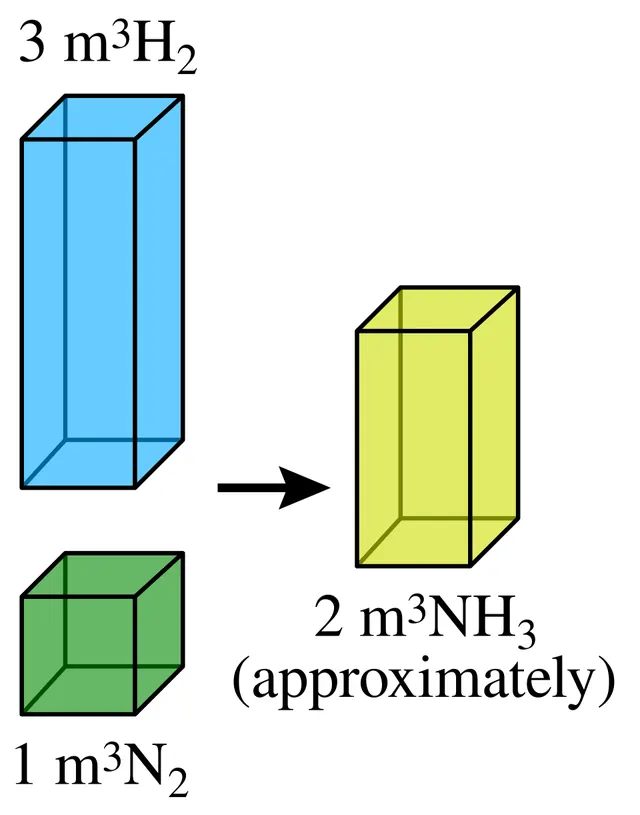
Figure illustrating Gay-Lussac's Law
Gay-Lussac's Law — DennisM · Public domain · source
Where you'll see it

What are examples of Gay-Lussac's Law?

The bursting can An aerosol can is a rigid sealed vessel; left in a hot car or thrown in a fire, its internal pressure rises with temperature until it can rupture: the reason for 'do not incinerate' warnings.
The pressure cooker Heating the trapped steam in a near-fixed volume raises its pressure, which raises the boiling point and cooks food faster, with a relief valve capping the rise.
Tyre pressure After hard driving or on a hot day, the gas in a tyre warms and, at roughly fixed volume, its measured pressure climbs — why the advice is to check pressures when tyres are cold.
Types & variants

What are the types of Gay-Lussac's Law?

Amontons's law§

The same pressure-temperature relationship under its historically prior name, after Guillaume Amontons, who established it around 1700: a century before Gay-Lussac.

The law of combining volumes§

A completely different law also called 'Gay-Lussac's law': gases reacting chemically do so in volume ratios of small whole numbers, announced in 1808 (a frequent source of confusion).

Why it matters

Why does Gay-Lussac's Law matter?

It completes the trio of simple gas laws linking pressure, volume, and temperature, and it explains a family of everyday hazards and devices, from bursting cans to pressure cookers. It is also a lesson in nomenclature: the single label 'Gay-Lussac's law' is attached to three different things, so precision about which one is meant matters.

Working with it

How do you apply Gay-Lussac's Law?

  • Work in kelvin at fixed volume — the proportionality holds only for absolute temperature in a rigid container of fixed gas; convert to kelvin and keep the volume constant.
  • Say which 'Gay-Lussac's law' you mean — distinguish the pressure-temperature law here from the law of combining volumes and from Charles's volume-temperature law, all of which share the name.
  • Respect the pressure it builds — sealed vessels can develop dangerous pressures when heated; design in relief and heed temperature limits.
Where it breaks down

What are the limits of Gay-Lussac's Law?

Like its siblings it holds only for an ideal gas, at constant volume and fixed amount, and requires absolute temperature. Real gases deviate at high pressure and low temperature, near condensation, where intermolecular forces and finite molecular volume matter. Its name is genuinely ambiguous: it denotes this pressure-temperature law (better called Amontons's law), the 1808 law of combining volumes, and sometimes the volume-temperature law now called Charles's law, so the label alone under-specifies which relationship is meant.

What it doesn't say

What are common misconceptions about Gay-Lussac's Law?

It is not the only 'Gay-Lussac's law', and it is arguably better named for Amontons, who found it a century earlier. It is also not exact for real gases, and it applies strictly at constant volume: confusing it with Charles's constant-pressure law or the law of combining volumes is the common error.

Is it real?

Is Gay-Lussac's Law real?

Yes, as far as the evidence goes. Gay-Lussac's Law is rated Empirical here: it rests on studies or measurements rather than on a saying.

Rated from two sources. 609 of the 1,116 entries carry this rating. How the scale works.

Occasionally printedin printed books: one of 240 names in its band, of 903 measured
45 of 55entries in chemistry & materials carry the same rating

The best-known laws are the least likely to rest on measurement.

Origin

Where did Gay-Lussac's Law come from?

The pressure-temperature relationship was established empirically by Guillaume Amontons around 1700 and measured more precisely across several gases by Joseph Louis Gay-Lussac in the early 1800s, whose name it conventionally carries. It was later explained by kinetic theory and absorbed into the ideal gas law.

How the name spread

When did people start saying “Gay-Lussac's Law”?

18002019
How often “Gay - Lussac 's Law” appears in printed English, which takes hold around 1866 and peaks around 1932. This tracks the phrase and not the idea. A law is usually older than the name for it. Source: Google Books Ngrams.
Known elsewhere as

What is Gay-Lussac's Law called in other languages?

  • Arabicقانون جاي-لوساك
  • GermanGesetz von Amontons
  • SpanishLey de Gay-Lussac
  • FrenchLoi de Gay-Lussac
  • Italianlegge di Gay-Lussac
  • Japaneseゲイ=リュサックの法則
  • PortugueseLei de Gay-Lussac
  • RussianЗакон Гей-Люссака
  • Chinese盖-吕萨克定律

9 languages, as recorded on Wikidata. These are names the idea already goes by, not translations we made. The whole index by language.

Sources

Sources & further reading

  1. 1Gay-Lussac's law, Wikipedia. — the three-way nomenclature, the combining-volumes law, and the Charles's-law crediting.secondary
  2. 2"Pressure and Temperature: Amontons's Law," University of Calgary Chemistry. — the canonical statement and the Amontons attribution.secondary

Everything above traces to en.wikipedia.org and chem-textbook.ucalgary.ca: two secondary sources, accounts of the original rather than the original itself, which has not been located for this entry. Nothing is written from memory, and the method is written down. Spot an error or a better source? Suggest a fix.

What we checked

  • 1,116entries in the tomeListed one by one on the browse page.
  • 1,116of them citing a sourceOpen any entry: its sources sit at the foot of the page.
  • 2,489source references in allEach is named, and linked wherever the source is online.