Kepler's Laws of Planetary Motion
"Planets trace ellipses, sweep equal areas in equal times, and orbit slower the farther out they are."
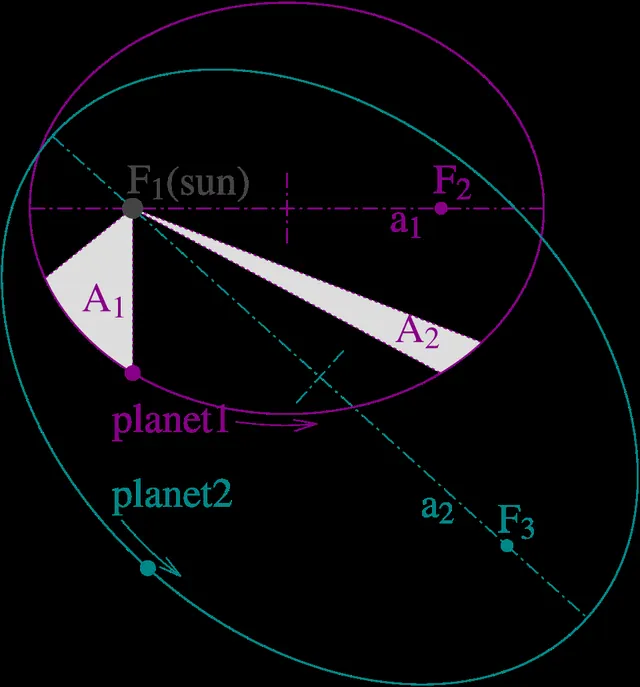
Three laws describe how planets move: their orbits are ellipses with the Sun at one focus; a line from planet to Sun covers equal areas in equal times, so a planet speeds up when nearer the Sun; and the square of a planet's orbital period grows with the cube of its average distance, tying the whole system together.
Rated Empirical: grounded in studies or measurable evidence. The other 608.
Kepler found the laws empirically, without knowing why they held; Newton later derived them from universal gravitation. The equal-areas law follows from conservation of angular momentum under any Sun-directed force; the period-distance law follows specifically from inverse-square gravity, where equating gravitational and centripetal force yields period squared proportional to distance cubed.
The deeper theory from which the three laws follow, and which generalised the third to include both masses, so the 'constant' actually depends on the total mass: the basis for weighing planets and stars.
The idealised, exactly solvable case of a single body orbiting another that the laws describe precisely, before the perturbations of real many-body systems intrude.
They replaced circles-upon-circles with a clean, predictive geometry of the heavens, gave Newton the target his gravitation had to hit, and still describe satellite and planetary orbits today. They are a landmark of turning precise observation into mathematical law.
The laws are exact only for an idealised two-body system. Real planets perturb one another, causing deviations from perfect Keplerian orbits, and Newtonian mechanics cannot fully account for the precession of Mercury's perihelion, which needed general relativity. Kepler's original third law also assumes negligible planetary mass; Newton generalised it to include both masses, so the proportionality constant depends on the total mass.
They are not fundamental first principles but empirical regularities later derived from gravitation: a limiting case of the deeper theory, not its foundation. Nor are they perfectly exact: mutual perturbations and relativity make real orbits depart from the ideal ellipse.
Yes, as far as the evidence goes. Kepler's Laws of Planetary Motion is rated Empirical here: it rests on studies or measurements rather than on a saying.
Rated from two sources. 609 of the 1,116 entries carry this rating. How the scale works.
The best-known laws are the least likely to rest on measurement.
Discovered by the German astronomer Johannes Kepler from the precise observations of Tycho Brahe: the first two laws published in Astronomia nova (1609), based on the orbit of Mars, and the third in Harmonices Mundi (1619). Newton later derived all three from his law of universal gravitation.
10 languages, as recorded on Wikidata. These are names the idea already goes by, not translations we made. The whole index by language.
Everything above traces to science.nasa.gov and en.wikipedia.org: two secondary sources, accounts of the original rather than the original itself, which has not been located for this entry. Nothing is written from memory, and the method is written down. Spot an error or a better source? Suggest a fix.
