Kirchhoff's Circuit Laws
also known as — Kirchhoff's current and voltage laws
"Currents balance at every junction and voltages sum to zero around every loop."
Two rules govern electrical circuits. The current law says the currents flowing into any junction equal those flowing out, so charge does not pile up. The voltage law says that adding up all the rises and drops around any closed loop returns you to the same potential, so they sum to zero.
Rated Empirical: grounded in studies or measurable evidence. The other 608.
The current law follows from conservation of charge: since charge cannot accumulate in a wire or junction, whatever current arrives must leave. The voltage law follows from energy conservation and a single-valued potential: more precisely, in the lumped-element model where changing magnetic fields stay inside components, the field outside is conservative, so the loop sum of voltages is zero.
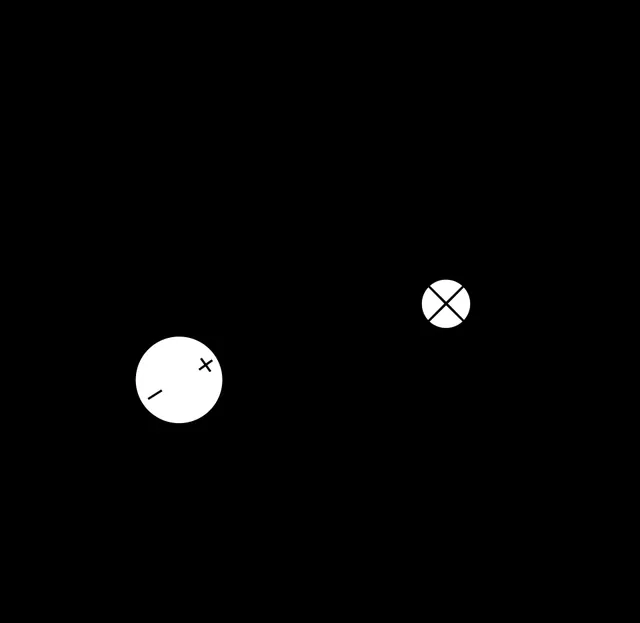
The constitutive relation combined with Kirchhoff's laws to solve networks; Kirchhoff's work generalised Ohm's from a single resistor to whole circuits.
The deeper theory of which both laws are corollaries in the low-frequency limit: the current law expresses charge continuity, the voltage law Faraday's law with negligible changing flux.
They are the foundation of circuit analysis, the rules every electrical engineer uses to solve networks of any complexity, taught in the first weeks of the subject. Together with Ohm's law they turn a tangle of components into solvable equations.
Both laws are the lumped-element idealisation, valid only in the quasi-static, low-frequency regime where the circuit is small compared with the wavelength. The voltage law fails when a time-varying magnetic field threads the loop, as with inductive coupling, since the loop integral of the field is then not zero. The current law fails where charge accumulates, as in high-frequency or capacitive and antenna effects, where the lumped-element model no longer applies. Beyond these limits one must use transmission-line theory or Maxwell's equations directly.
These are Kirchhoff's circuit laws, about charge and energy in electrical networks, not his separate law of thermal radiation, though the same person gave both. And they are approximations valid at low frequency, failing where changing magnetic fields thread a loop or charge accumulates.
Yes, as far as the evidence goes. Kirchhoff's Circuit Laws is rated Empirical here: it rests on studies or measurements rather than on a saying.
Rated from three sources. 609 of the 1,116 entries carry this rating. How the scale works.
The best-known laws are the least likely to rest on measurement.
Formulated by the German physicist Gustav Kirchhoff in 1845, as a student under Franz Neumann, generalising Ohm's earlier work; both are later understood as corollaries of Maxwell's equations in the low-frequency limit.
10 languages, as recorded on Wikidata. These are names the idea already goes by, not translations we made. The whole index by language.
Everything above traces to doi.org and en.wikipedia.org, three sources in all, one of them the original publication rather than an account of it. Nothing is written from memory, and the method is written down. Spot an error or a better source? Suggest a fix.
