Koomey's Law
"The computation you get per unit of energy has doubled about every year and a half."
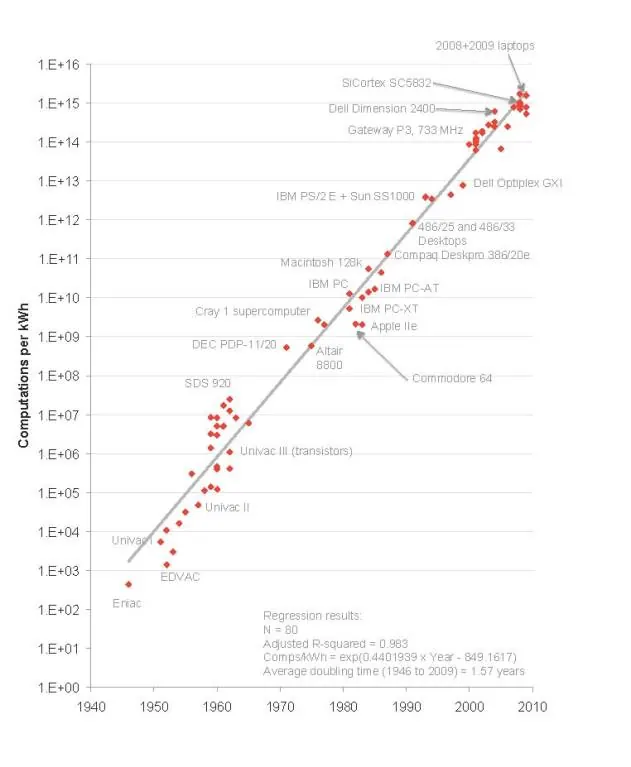
The energy efficiency of computing, useful computation per joule dissipated, has improved exponentially over time. It matters most for battery-powered and mobile devices: for a fixed amount of work, the energy, and therefore the battery, needed keeps falling, so devices can do more per charge or shrink.
Rated Empirical: grounded in studies or measurable evidence. The other 608.
Efficiency gains came largely from smaller, lower-power transistors: more and faster switching per unit of energy as feature sizes shrank. Historically this tracked Moore's-law density scaling combined with Dennard scaling, in which power density stayed roughly constant as transistors got smaller.
The density counterpart — transistor counts doubling roughly every two years. Koomey's law measures efficiency rather than count, and the two are historically linked but distinct.
The principle that power density stays constant as transistors shrink. Its breakdown around 2005 is central to the slowdown of Koomey's law.
It reframed the story of computing progress around energy rather than speed, which is the metric that actually governs mobile, embedded, and data-centre computing. With a strong historical fit over roughly half a century, it explained why devices kept doing more on less power, and its slowdown now signals real physical limits ahead.
The doubling slowed after about 2000, from roughly every 1.57 years toward every 2.6 years, as Dennard scaling ended around 2005 and Moore's law itself decelerated: the difference between about a hundredfold and only a sixteenfold gain per decade. Later analyses report continued deceleration. Landauer's principle sets a thermodynamic lower bound on the energy for irreversible computation, which efficiency gains must eventually hit; estimates of when the bound is approached are projections, not facts. It is an observed historical regularity that has already changed slope, not a guaranteed law of nature, and the headline 1.57-year figure is a trendline fit rather than a round number Koomey advertised.
It is a fitted empirical trend, not a physical law, and it has measurably slowed, so the year-and-a-half doubling describes the past, not a promise. The 1.57-year figure comes from fitting the long-run data; Koomey himself rounds it to 'about every year and a half'.
Yes, as far as the evidence goes. Koomey's Law is rated Empirical here: it rests on studies or measurements rather than on a saying.
Rated from two sources. 609 of the 1,116 entries carry this rating. How the scale works.
The best-known laws are the least likely to rest on measurement.
From work by Jonathan Koomey and colleagues, published as 'Implications of Historical Trends in the Electrical Efficiency of Computing' (IEEE Annals of the History of Computing, 2011) and popularised around 2010–2011. Koomey later documented the post-2000 slowdown himself; the name was applied by others.
5 languages, as recorded on Wikidata. These are names the idea already goes by, not translations we made. The whole index by language.
Everything above traces to two pages on en.wikipedia.org, one of them the original publication rather than an account of it. Nothing is written from memory, and the method is written down. Spot an error or a better source? Suggest a fix.
