Markovnikov's Rule
"When acid adds to a lopsided double bond, the hydrogen goes to the carbon that already has more."
 From the Librarian's card index. No source, no stamp.
"When acid adds to a lopsided double bond, the hydrogen goes to the carbon that already has more."
From the Librarian's card index. No source, no stamp.
In the addition of a hydrogen halide, or another polar reagent, across an unsymmetrical carbon-carbon double bond, the hydrogen attaches to the double-bond carbon that already bears the most hydrogens, and the halide goes to the more substituted carbon. The mnemonic is that the rich get richer. It predicts which of two possible products dominates: the regiochemistry of the reaction.
Rated Empirical: grounded in studies or measurable evidence. The other 608.
The rule falls out of carbocation stability. The double bond is first protonated, and it protonates in whichever way gives the more stable carbocation: a more substituted cation, tertiary over secondary over primary, stabilised by the electron-donating alkyl groups around it. The halide then attacks that cation, landing on the more substituted carbon. Markovnikov's own 1870 statement was purely empirical, a pattern read off the products; the electronic explanation came decades later, once carbocations and the theory of electron-releasing groups were understood.
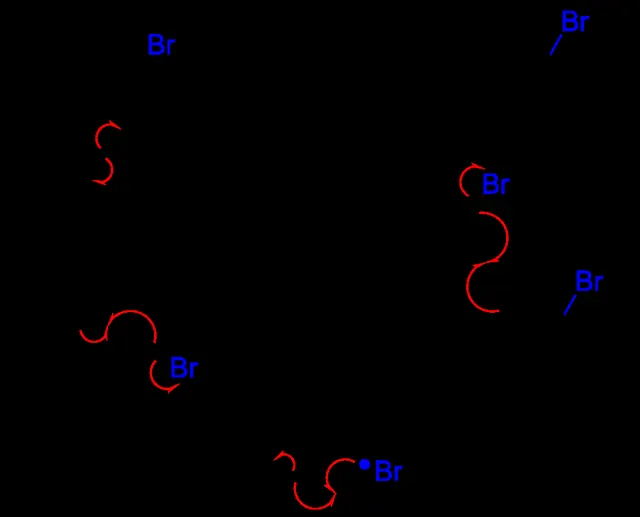
Kharasch and Mayo's 1933 discovery that peroxides switch hydrogen bromide addition to a radical chain, giving the anti-Markovnikov product; a bromine radical adds first to form the more stable carbon radical, reversing the regiochemistry.
A route to net anti-Markovnikov hydration: borane adds across the double bond through a concerted transition state with no carbocation, placing boron, and ultimately the hydroxyl, on the less hindered carbon.
It is one of the first predictive rules of organic chemistry, letting a chemist foresee the major product of adding an acid to an alkene, and its explanation is a cornerstone lesson in how carbocation stability governs reactions. Just as instructive is its exception: the peroxide effect that reverses it was a landmark in the discovery of radical chain mechanisms.
It is an empirical regioselectivity rule for ionic, carbocation-mediated addition to simple alkenes, not a universal law. It is reversed by radical conditions: the peroxide effect gives anti-Markovnikov addition, but only for hydrogen bromide, not hydrogen chloride, fluoride, or iodide, whose bond energies make the radical chain unfavourable. Non-carbocation mechanisms such as hydroboration follow their own regiochemistry. And it can mislead where carbocations rearrange to more stable isomers, or where electron-withdrawing substituents invert the expected charge stabilisation. Markovnikov himself, working before electronic theory, could state the pattern but not explain it.
The rule that hydrogen goes to the carbon with more hydrogens is the observation, not the reason; the real driver is the stability of the carbocation intermediate, and the hydrogen-count phrasing is a shortcut that happens to agree. And an anti-Markovnikov result does not mean the rule is wrong. It means a different mechanism, radical or concerted, is at work, each following its own consistent logic.
Yes, as far as the evidence goes. Markovnikov's Rule is rated Empirical here: it rests on studies or measurements rather than on a saying.
Rated from two sources. 609 of the 1,116 entries carry this rating. How the scale works.
The best-known laws are the least likely to rest on measurement.
Stated by the Russian chemist Vladimir Markovnikov in 1870, in a German-language paper drawn from his work on isomeric butyric acids; sometimes spelled Markownikoff in older literature. Its carbocation basis was worked out over the following decades, and Kharasch and Mayo identified the reversing peroxide effect in 1933.
9 languages, as recorded on Wikidata. These are names the idea already goes by, not translations we made. The whole index by language.
Everything above traces to en.wikipedia.org and pubs.acs.org, two sources in all, one of them the original publication rather than an account of it. Nothing is written from memory, and the method is written down. Spot an error or a better source? Suggest a fix.
