Moore's Law
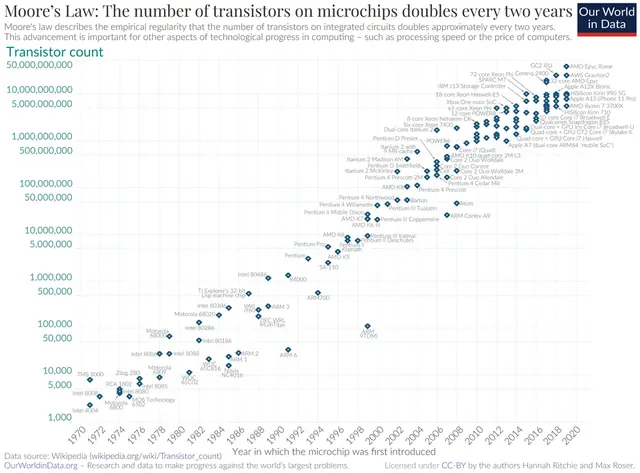
"The number of transistors on a chip roughly doubles every two years."
"The number of transistors on a chip roughly doubles every two years."
Semiconductor makers have, for decades, been able to pack about twice as many transistors into the same chip area every couple of years, so computing capability per chip grows exponentially while cost per component falls.
Rated Empirical: grounded in studies or measurable evidence. The other 608.
It is not a law of physics but an empirical trend that became an industry roadmap and, in part, a self-fulfilling target. The doubling was sustained by deliberate, coordinated investment in lithography and process technology: because every maker expected its rivals to hit the trend, each planned toward it, which helped make the prediction come true. It is a statement about density and cost economics, not directly about speed.
Robert Dennard's 1974 companion observation: as transistors shrink, power density stays roughly constant. It broke down around 2005–2006 as leakage currents rose, ending 'free' clock-speed gains and forcing the shift to multi-core.
Jonathan Koomey's finding that computations per joule of energy doubled about every 1.6 years for half a century: with the doubling slowing after 2000. The efficiency counterpart to Moore's density trend.
Niklaus Wirth's rejoinder: software gets slower faster than hardware gets faster. Bloat quietly consumes the gains Moore's law delivers.
For half a century it was the metronome of the digital age: product roadmaps, software ambitions, and whole business models were built on the assumption that compute would keep getting exponentially cheaper. Understanding that it is an economic trend and not a physical guarantee matters most now, as it slows.
Moore's law is an observation, not a law of nature: no physical principle guarantees it, and its pace has slowed since about 2010 as scaling approaches atomic and quantum-tunnelling limits and fabrication costs soar. Its 'death' has been declared many times (an Nvidia chief called it dead in 2022; Intel's disagreed days later). It is also partly self-fulfilling: because the industry explicitly targeted the roadmap, its persistence reflects coordinated intent as much as technological inevitability. It describes transistor density; the popular reading as a law of ever-doubling 'speed' conflates it with the separate, and now-broken, Dennard scaling.
It is not a physical law, and not a promise that computers double in speed every two years. It is about transistor count and cost, was originally stated as yearly (1965) before Moore revised it to two years (1975), and the '18 months' version is David House's performance figure, not Moore's.
Yes, as far as the evidence goes. Moore's Law is rated Empirical here: it rests on studies or measurements rather than on a saying.
Rated from three sources. 609 of the 1,116 entries carry this rating. How the scale works.
The best-known laws are the least likely to rest on measurement.
Nothing here is the formal negation of Moore's Law — these are the entry in this index that pulls the other way, so that following both at once forces a choice.
Stated by Gordon Moore, then head of R&D at Fairchild Semiconductor and later co-founder of Intel, in a 1965 Electronics magazine article, 'Cramming more components onto integrated circuits'. His original rate was a doubling roughly every year; he revised it to every two years in 1975. The name is usually credited to the Caltech professor Carver Mead.
10 languages, as recorded on Wikidata. These are names the idea already goes by, not translations we made. The whole index by language.
Everything above traces to cs.utexas.edu, en.wikipedia.org and computerhistory.org, three sources in all, one of them the original publication rather than an account of it. Nothing is written from memory, and the method is written down. Spot an error or a better source? Suggest a fix.
