Preferential Attachment
also known as — The rich get richer, The Barabási-Albert model
"New links in a growing network attach preferentially to nodes that already have many, so the well-connected grow fastest."
Preferential attachment is a network-growth mechanism in which a network expands by adding nodes over time, and each new node connects to existing nodes with a probability proportional to how many connections they already have. Because the already-popular are the most likely to gain still more, the mechanism is a rich-get-richer dynamic. Repeated over a growing network it produces a scale-free degree distribution, in which the fraction of nodes with a given number of links follows a power law: a few enormously connected hubs coexist with a vast majority of sparsely connected nodes, and there is no typical scale.
Rated Empirical: grounded in studies or measurable evidence. The other 608.
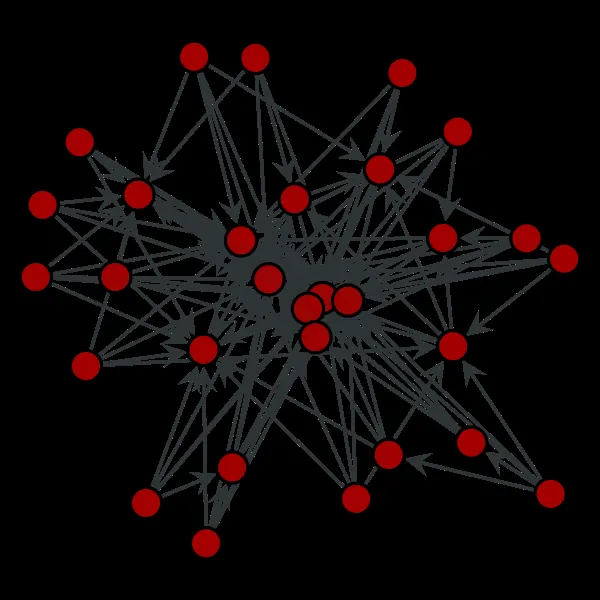
Two ingredients combine. First, growth: the network continually adds new vertices. Second, preferential attachment: those vertices link preferentially to already-well-connected sites. A node that starts with more links has a higher chance of catching each new link, which widens its lead, a positive-feedback loop. In the canonical model this linear-in-degree rule yields a power-law degree distribution with an exponent near three. The result is a scale-free structure with hubs, which is robust to random failure, since a randomly removed node is almost always an unimportant one, but fragile to targeted attack, since removing the few hubs shatters the network fast.
Price's 1976 name for the same rich-get-richer process in citation networks, essentially the modern model published more than two decades before it was renamed preferential attachment.
Robert Merton's sociological sibling of the mechanism, in which eminent scientists get disproportionate credit, the same dynamic described in the language of reward rather than links.
Preferential attachment gave network science a simple generative explanation for why hubs and heavy-tailed degree distributions are so common, tying the structure of real networks to a single growth rule rather than to chance. It reframed the ubiquity of inequality in connections, citations, wealth, and popularity as the natural output of proportional growth, and it made scale-free networks, with their robust-yet-fragile character, a central object of study across the web, biology, and infrastructure. It also connected a scattered family of ideas, the Yule process, cumulative advantage, the Matthew effect, and Gibrat's law, under one mechanism.
Barabási and Albert named and generalised the idea but did not originate it: Yule in 1925, Herbert Simon in 1955, and Price in 1976 all modelled the mechanism earlier, and credit for the citation-network version belongs to Price. Whether real networks are truly scale-free is genuinely contested: Broido and Clauset's 2019 analysis of nearly a thousand empirical networks found strong scale-free structure to be rare, with many networks better fit by other heavy-tailed forms such as the lognormal, though the finding was itself debated. The pure model fixes the exponent near three, cannot easily reproduce the varied exponents and high clustering of real networks, and ignores node fitness and ageing, prompting many extensions.
Barabási and Albert did not invent the idea; they named and popularised a mechanism anticipated by Yule, Simon, and especially Price. Scale-free does not describe every large real network; the empirical support is mixed. Preferential attachment is not the only route to a power law, since optimisation and multiplicative random processes can produce one too, so a heavy tail does not by itself prove the mechanism. And scale-free, a property of the degree distribution, is not the same as small-world, a property of path lengths and clustering.
Yes, as far as the evidence goes. Preferential Attachment is rated Empirical here: it rests on studies or measurements rather than on a saying.
Rated from two sources. 609 of the 1,116 entries carry this rating. How the scale works.
The best-known laws are the least likely to rest on measurement.
Anticipated by Udny Yule (1925), Herbert Simon (1955), and Derek de Solla Price (1976), and named and generalised by Albert-László Barabási and Réka Albert in their 1999 Science paper 'Emergence of scaling in random networks'.
3 languages, as recorded on Wikidata. These are names the idea already goes by, not translations we made. The whole index by language.
Everything above traces to pubmed.ncbi.nlm.nih.gov and nature.com, two sources in all, one of them the original publication rather than an account of it. Nothing is written from memory, and the method is written down. Spot an error or a better source? Suggest a fix.
