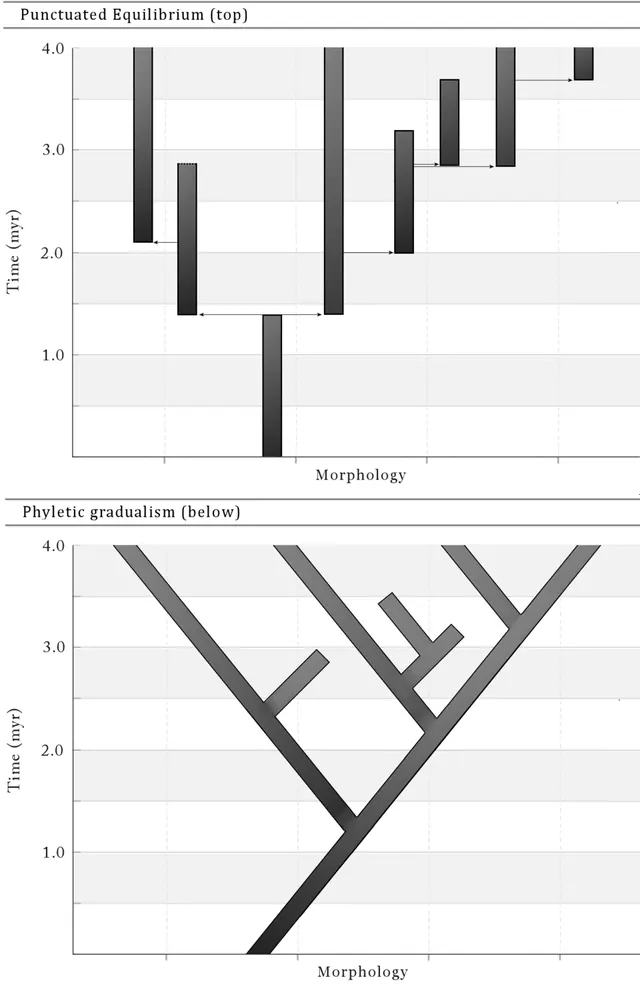
Punctuated equilibrium is the hypothesis that evolution as recorded in the fossil record proceeds not by slow, steady, gradual transformation of whole lineages, but by long periods of morphological stasis, little or no net change, punctuated by rare, geologically rapid episodes of change usually tied to speciation. On this view the apparent gaps and sudden appearances in the fossil record are not artefacts of missing data but a real signal: species linger largely unchanged for most of their existence, and significant change is concentrated into brief intervals when new species split off. Proposed by Niles Eldredge and Stephen Jay Gould in 1972, it challenged the assumption of uniform, gradual change.
Reliability
EmpiricalHeuristicFolk-adageContested
Rated Contested: disputed, with the evidence still argued over. The other 256.
Lineage
How it works
How does Punctuated Equilibrium work?
The model rests on Ernst Mayr's theory of speciation in small, peripherally isolated populations. Because such populations are small and cut off from the stabilising gene flow of the main population, they can change rapidly and are unlikely to leave fossils, so when the new form appears in the record it seems to arrive abruptly and then persist, largely static, until it too is replaced. Stasis is treated as data in its own right, an active pattern to be explained rather than an absence of evolution. Rapid here is geological, on the order of thousands to tens of thousands of years, still many generations of ordinary microevolution.
Trilobites Eldredge's work on Phacops trilobites, showing long stasis punctuated by rapid shifts, was one of the two original lines of evidence in the 1972 paper.
Land snails Gould's study of Bermudian pulmonate gastropods, the second founding case, likewise showed extended stasis interrupted by brief episodes of change.
Bryozoans Later fossil studies of bryozoan colonies became a frequently cited test case for stasis and punctuation across many millions of years.
The insistence that long periods of morphological constancy are a real, dominant pattern requiring explanation, not merely gaps or an absence of evidence.
The contrasting classical view that lineages transform slowly and steadily as whole populations, against which punctuated equilibrium was posed.
Why it matters
Why does Punctuated Equilibrium matter?
Punctuated equilibrium reshaped debates about the tempo and mode of evolution, drawing attention to stasis as a phenomenon and to the role of speciation in generating morphological change. It stimulated decades of quantitative work in palaeobiology on how often lineages are static versus gradually changing, and it sharpened thinking about the relationship between microevolution within populations and macroevolutionary patterns across geological time. Even critics who see it as a modest adjustment to gradualism acknowledge that it forced the field to test, rather than assume, the pace of evolutionary change.
Working with it
How do you apply Punctuated Equilibrium?
Expect stasis then bursts — read the fossil record as long stretches of little change interrupted by brief, rapid episodes tied to speciation, rather than uniform gradual drift.
Treat stasis as a signal — take extended morphological constancy as a real pattern to be explained, not as missing data.
Read rapid geologically — understand punctuations as brief in geological terms, thousands of years, still spanning many generations of ordinary evolution.
Where it breaks down
What are the limits of Punctuated Equilibrium?
How general stasis and punctuation really are, against gradual change, remains genuinely debated in palaeobiology, and the empirical mix of patterns is unsettled. Richard Dawkins and other neo-Darwinists argued that punctuated equilibrium is a minor gloss on gradualism rather than a revolution, a claim about rates within the modern synthesis, and that some apparent punctuations reflect the migration of a new population into an area rather than in-place evolution. Commonly cited figures for the proportion of species showing stasis, or for the duration of punctuations, come from secondary summaries and should be treated as approximate.
What it doesn't say
What are common misconceptions about Punctuated Equilibrium?
It is not saltationism: the punctuations are geologically rapid but biologically gradual, spanning many generations, not single-generation hopeful-monster jumps. It does not deny natural selection or require non-Darwinian mechanisms; it is a claim about tempo and mode within standard evolutionary theory. It is emphatically not evidence against evolution, though creationists routinely and wrongly cite it that way, a misuse Gould himself repudiated. And rapid is relative to geological time, not to a human timescale.
Is it real?
Is Punctuated Equilibrium real?
That is exactly what is in dispute. Punctuated Equilibrium is rated Contested here: the effect is claimed, the evidence is argued over, and specialists disagree.
Proposed by Niles Eldredge and Stephen Jay Gould in their 1972 paper 'Punctuated Equilibria: An Alternative to Phyletic Gradualism', building on Ernst Mayr's theory of speciation in small, isolated populations.
How the name spread
When did people start saying “Punctuated Equilibrium”?
1800coined 19722019
How often “Punctuated Equilibrium” appears in printed English, which takes hold around 1984 and peaks around 2016. Coined 1972 and in print by about 1984, unusually close together. This still charts the phrase rather than the idea. Source: Google Books Ngrams.
Known elsewhere as
What is Punctuated Equilibrium called in other languages?
Everything above traces to doi.org, en.wikipedia.org and talkorigins.org, three sources in all, one of them the original publication rather than an account of it. Nothing is written from memory, and the method is written down. Spot an error or a better source? Suggest a fix.
What we checked
1,116entries in the tomeListed one by one on the browse page.
1,116of them citing a sourceOpen any entry: its sources sit at the foot of the page.
2,489source references in allEach is named, and linked wherever the source is online.
 From the Librarian's card index. No source, no stamp.