The Biogenetic Law
also known as — Recapitulation theory, Ontogeny recapitulates phylogeny
"An embryo was said to replay the adult forms of its evolutionary ancestors."
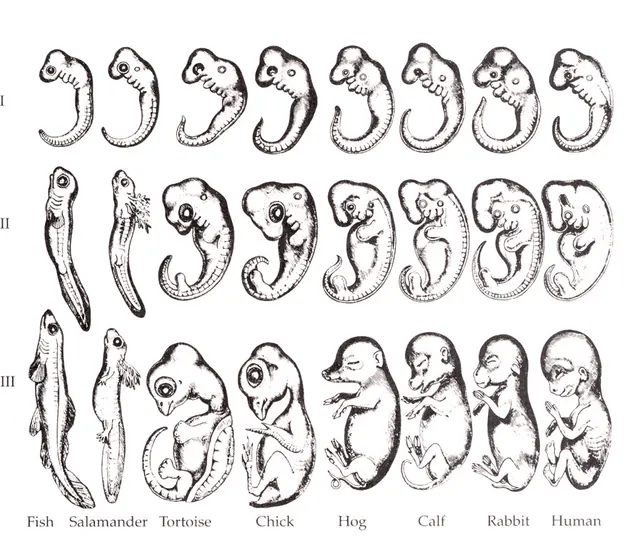
The biogenetic law, associated with Ernst Haeckel, claimed that the embryonic development of an individual replays the adult ancestral forms of its species: ontogeny recapitulates phylogeny. On this view a developing embryo passes in compressed sequence through stages resembling its lineage's adult ancestors, so a human embryo was said to pass through a fish-like adult stage, then an amphibian-like one, climbing an evolutionary ladder. In its strong Haeckelian form the law is now discredited.
Rated Contested: disputed, with the evidence still argued over. The other 256.
Haeckel proposed that evolution proceeds by terminal addition: a new final stage is tacked onto the end of development at each evolutionary step, pushing earlier ancestral stages back to appear earlier in the embryo, so development recapitulates ancestry. This is exactly the mechanism that fails. Karl Ernst von Baer had already observed the truth: embryos of related animals resemble each other's embryos, not each other's adults, and development proceeds from the general to the special by divergence, not by a linear climb through ancestral adults.
The earlier recapitulationist idea, from Meckel and Serres in the early nineteenth century, that higher organisms' embryos pass through stages resembling lower adult forms, which Haeckel's law extended.
The modern refinement of von Baer: embryos of a phylum are most similar not at the earliest stage but at a mid-development phylotypic stage, with more variation before and after.
It was one of the most influential ideas in nineteenth-century biology, shaping embryology, comparative anatomy, and the popular imagination of evolution, and its later collapse is a landmark case in the history of science. What survives (that embryos share conserved features from common descent, and that a real phylotypic stage exists) seeded modern evolutionary developmental biology, which follows von Baer rather than Haeckel.
The strong Haeckelian law is discredited. Embryos do not pass through the adult stages of their ancestors; they resemble the embryos of related species, as von Baer observed, and the shortcomings were recognised by the early twentieth century, the law relegated to biological mythology by mid-century. Haeckel's embryo drawings overstated similarities and were not to scale, though whether this amounts to deliberate fraud is a contested historical judgement. What remains valid is narrow: shared embryonic features reflecting common descent, and a genuine phylotypic stage of maximum similarity — neither of which is recapitulation of adult ancestry.
Gill slits in a human embryo do not mean humans once passed through an adult fish stage; they are pharyngeal arches resembling the embryonic structures of fish, evidence of shared ancestry. The strong recapitulation law is not still valid science. But the opposite over-correction is also wrong: embryos do carry an evolutionary signal through conserved features and the phylotypic stage (the inaccuracy of Haeckel's drawings does not erase common descent or von Baer's observation-based laws).
That is exactly what is in dispute. The Biogenetic Law is rated Contested here: the effect is claimed, the evidence is argued over, and specialists disagree.
Rated from three sources. 257 of the 1,116 entries carry this rating. How the scale works.
The best-known laws are the least likely to rest on measurement; the full verdict on The Biogenetic Law.
Nothing here is the formal negation of The Biogenetic Law — these are the entry in this index that pulls the other way, so that following both at once forces a choice.
Formulated by Ernst Haeckel in 1866 in his 'General Morphology of Organisms,' extending the earlier Meckel-Serres law; opposed from the start by Karl Ernst von Baer's 1828 laws, and its strong form discredited over the twentieth century, with Michael Richardson's 1997 re-examination of the embryo drawings a notable turning point.
Everything above traces to en.wikipedia.org, pubmed.ncbi.nlm.nih.gov and embryo.asu.edu, three sources in all, one of them the original publication rather than an account of it. Nothing is written from memory, and the method is written down. Spot an error or a better source? Suggest a fix.
