Vol. I a living index of named laws · est. mmxxvi no ads · no tracking
The Law Tomeindex of named laws

The Doppler Effect

also known as — The Doppler-Fizeau effect
"A wave's pitch or colour shifts up as its source approaches and down as it recedes."
In plain English

What does The Doppler Effect mean?

The frequency of a wave that an observer detects changes when the source and observer move relative to one another. Approaching, the observed frequency is higher than emitted; receding, it is lower. The source's own output never changes, only what the observer receives, because of the relative motion.
In symbols

What is the formula for The Doppler Effect?

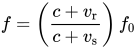
f = \left( \frac{c + v_\text{r}}{c + v_\text{s}} \right) f_0
The defining formula as recorded on Wikidata. f = \left( \frac{c + v_\text{r}}{c + v_\text{s}} \right) f_0
Run the numbers

The Doppler Effect calculator

Approach and the pitch rises, recede and it falls, and the sums are not symmetric.

f2 = f (v + vo) / (v - vs), v = 343 m/s

f
Emitted frequency Hz
vs
Source speed toward you m/s
vo
Your speed toward the source m/s
Frequency you hear —
Shift —
Source is supersonic —

Computed live from f2 = f (v + vo) / (v - vs), v = 343 m/s — the law's own arithmetic, nothing fitted or predicted.

Reliability

Rated Empirical: grounded in studies or measurable evidence. The other 608.

Lineage
1842COINED
How it works

How does The Doppler Effect work?

Relative motion compresses or stretches successive wavefronts. As a source approaches, each wave cycle is emitted from a position closer to the observer than the last, shortening the interval between cycles and raising the frequency; as it recedes, the cycles are emitted from ever-farther positions, lengthening the interval and lowering the frequency. The crests bunch up ahead of the moving source and spread out behind it.
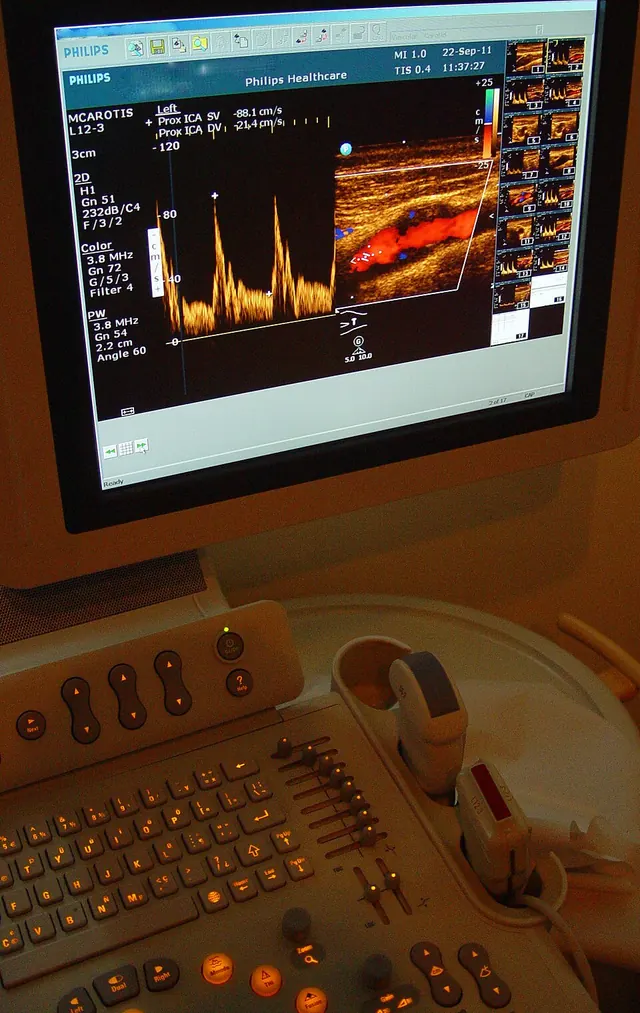
Figure illustrating The Doppler Effect
The Doppler Effect — Etan J. Tal · CC BY 3.0 · source
Where you'll see it

What are examples of The Doppler Effect?

The passing siren An ambulance siren sounds higher-pitched as it approaches and drops abruptly to a lower pitch as it passes and recedes: the everyday demonstration, though the siren's emitted note never changes.
Redshift and blueshift The motion of stars and galaxies shifts their spectral lines (toward the blue when approaching, the red when receding) letting astronomers measure velocities across the universe.
Radar and ultrasound Police speed guns and weather radar read the frequency shift of reflected waves to find a target's velocity, and medical Doppler ultrasound measures blood flow the same way.
Types & variants

What are the types of The Doppler Effect?

The relativistic Doppler effect§

The version for speeds approaching that of light, where special-relativistic time dilation modifies the classical formula and produces even a transverse shift with no classical counterpart.

Cosmological redshift§

The reddening of light from distant galaxies, often described in Doppler terms but more accurately due to the expansion of space itself rather than motion through it.

Why it matters

Why does The Doppler Effect matter?

It is a phenomenon of every kind of wave, from sound to light, and one of the most useful in science and technology. It gave astronomy the means to measure cosmic motion and expansion, and it underlies radar, sonar, weather forecasting, and medical imaging.

Working with it

How do you apply The Doppler Effect?

  • Read approach and recession in the shift — take a rise in observed frequency as motion toward you and a fall as motion away.
  • Turn the shift into a speed — use the size of the frequency change to measure how fast a source or reflector is moving, as radar and ultrasound do.
  • Switch to the relativistic form at high speed — when relative speeds approach that of light, apply the relativistic formula, which adds time dilation.
Where it breaks down

What are the limits of The Doppler Effect?

The classical formula assumes relative speeds much smaller than the wave speed; near the speed of light the relativistic version, including time dilation, must be used, and it predicts a transverse shift absent classically. For sound and other waves in a medium, the effect depends separately on the motion of source, observer, and medium, so a moving source is not equivalent to a moving observer; for light in vacuum only the relative velocity matters. Cosmological redshift, though Doppler-like, is better understood as the stretching of space, not motion through it.

What it doesn't say

What are common misconceptions about The Doppler Effect?

Doppler's own 1842 application was partly wrong: he thought the effect explained the visible colours of stars, but stellar speeds are far too small for that, and the real signature is a shift of spectral lines, as Fizeau clarified. And the cosmological redshift is not simply the Doppler effect: mainstream cosmology attributes it to the expansion of space.

Is it real?

Is The Doppler Effect real?

Yes, as far as the evidence goes. The Doppler Effect is rated Empirical here: it rests on studies or measurements rather than on a saying.

Rated from two sources. 609 of the 1,116 entries carry this rating. How the scale works.

Widely printedin printed books: one of 99 names in its band, of 903 measured
121 of 129entries in physics & the physical world carry the same rating

The best-known laws are the least likely to rest on measurement.

Origin

Where did The Doppler Effect come from?

Predicted by the Austrian physicist Christian Doppler in an 1842 paper in Prague; tested for sound by Buys Ballot in 1845 using trumpeters on a moving train, and described independently for light by Hippolyte Fizeau in 1848.

How the name spread

When did people start saying “The Doppler Effect”?

1800coined 18422019
How often “Doppler Effect” appears in printed English, which takes hold around 1904 and peaks around 1963. The idea dates to 1842: the phrase took about 62 years to reach print in any quantity, which is the gap this chart measures. Source: Google Books Ngrams.
Known elsewhere as

What is The Doppler Effect called in other languages?

  • Arabicتأثير دوبلر
  • GermanDopplereffekt
  • Spanishefecto Doppler
  • Frencheffet Doppler
  • Hindiडॉप्लर प्रभाव
  • Italianeffetto Doppler
  • Japaneseドップラー効果
  • Portugueseefeito Doppler
  • Russianэффект Доплера
  • Chinese多普勒效应

10 languages, as recorded on Wikidata. These are names the idea already goes by, not translations we made. The whole index by language.

Sources

Sources & further reading

  1. 1Doppler effect, Wikipedia. — the frequency-shift statement, the wavefront mechanism, the applications, and the relativistic version.secondary
  2. 2C. H. D. Buys Ballot, Wikipedia. — the 1845 railway experiment confirming the effect for sound.secondary

Everything above traces to two pages on en.wikipedia.org: both secondary, accounts of the original rather than the original itself, which has not been located for this entry. Nothing is written from memory, and the method is written down. Spot an error or a better source? Suggest a fix.

What we checked

  • 1,116entries in the tomeListed one by one on the browse page.
  • 1,116of them citing a sourceOpen any entry: its sources sit at the foot of the page.
  • 2,489source references in allEach is named, and linked wherever the source is online.