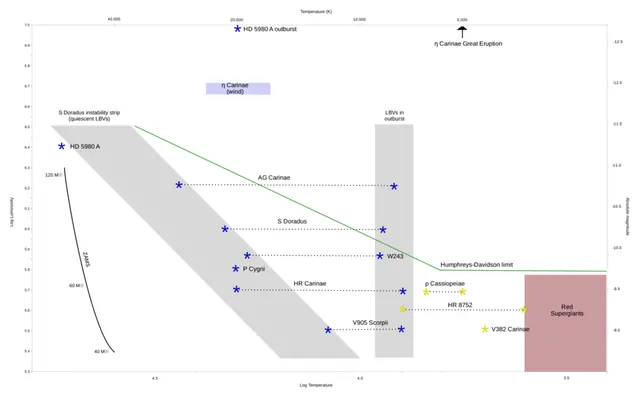
The Eddington limit is the maximum luminosity a body can sustain when the outward push of its own radiation pressure just balances the inward pull of gravity. Shine any brighter and radiation pressure overwhelms gravity, driving the outer layers of a star outward or halting the infall of matter onto a compact object. Named for Arthur Eddington and worked out in the study of stellar structure, the limit is proportional to mass, so more massive objects can be more luminous. It sets a natural ceiling on the brightness of stars and on how fast black holes and neutron stars can swallow matter and grow.
Reliability
EmpiricalHeuristicFolk-adageContested
Rated Empirical: grounded in studies or measurable evidence. The other 608.
Lineage
How it works
How does The Eddington Limit work?
The balance is between two forces acting on an ionised gas. Radiation pressure acts mainly on the electrons, which scatter photons efficiently through Thomson scattering, while gravity acts mainly on the far heavier protons; the two species are locked together by electrical forces, so the plasma responds as a whole. Setting the outward radiation force equal to the inward gravitational force gives a luminosity proportional to the mass, about 1.26 times ten to the thirty-first watts for each solar mass, or equivalently some thirty thousand times the Sun's luminosity per solar mass. Above this luminosity, radiation wins and matter is expelled or prevented from accreting.
Massive stars The most massive, luminous stars sit near their Eddington limit and shed mass in powerful winds and outbursts, because their radiation is close to overpowering their own gravity.
Feeding black holes The limit caps the steady rate at which a black hole or neutron star can accrete, since radiation from infalling matter pushes back, constraining how fast supermassive black holes can grow.
Ultraluminous X-ray sources Some X-ray sources appear to shine above the limit for their mass, the super-Eddington puzzle, explained by beamed or non-spherical accretion rather than a violation of the physics.
Regimes in which the apparent luminosity exceeds the classical limit through non-spherical geometry, beaming, or photon trapping in thick accretion flows, rather than a true breach of the balance.
The classical limit assumes electron scattering dominates the opacity; heavier elements and line opacity can lower the effective limit for real, chemically enriched gas.
Why it matters
Why does The Eddington Limit matter?
The Eddington limit is a fundamental ceiling in astrophysics, setting the maximum luminosity of stars and the maximum steady rate at which compact objects can accrete and grow. It shapes the structure and mass loss of the most massive stars, governs the physics of quasars and active galactic nuclei, and constrains how quickly the supermassive black holes at galactic centres could have grown in the early universe. Wherever gravity and radiation contend, from a single star to a feeding black hole, the Eddington limit marks the balance point between them.
Working with it
How do you apply The Eddington Limit?
Balance light against gravity — treat the Eddington limit as the luminosity at which outward radiation pressure just offsets inward gravity, above which matter is expelled.
Scale with mass — expect the maximum luminosity to grow in proportion to mass, so more massive stars and black holes can be more luminous.
Cap the accretion — use the limit to bound the steady rate at which a compact object can swallow matter, since accretion light pushes infalling gas back.
Where it breaks down
What are the limits of The Eddington Limit?
The classical Eddington limit assumes spherical symmetry, a steady state, and that electron, or Thomson, scattering dominates the opacity, as in fully ionised hydrogen, and these assumptions are often violated in real systems. Objects can exceed the limit transiently or through non-spherical geometry, beaming, or photon trapping, which is how ultraluminous X-ray sources shine apparently super-Eddington without breaking the physics. The exact value also depends on chemical composition, since heavier elements and line opacity change the effective opacity and lower the limit, so the simple formula is an idealisation.
What it doesn't say
What are common misconceptions about The Eddington Limit?
It is not an absolute cap that can never be crossed; it is the steady, spherical balance point, and transient or geometrically beamed sources genuinely exceed it in apparent luminosity. The limit depends on mass, not on the object's radius, which cancels because both forces fall off with the square of distance. And although the proton mass appears in the formula, the relevant cross-section is the electron's, reflecting that electrons scatter the radiation while protons carry the weight.
Is it real?
Is The Eddington Limit real?
Yes, as far as the evidence goes. The Eddington Limit is rated Empirical here: it rests on studies or measurements rather than on a saying.
Developed by Arthur Eddington in his work on the internal structure of stars in the 1920s, notably in his 1926 'The Internal Constitution of the Stars'.
How the name spread
When did people start saying “The Eddington Limit”?
1800coined 19262019
How often “Eddington Limit” appears in printed English, which takes hold around 1971 and peaks around 1976. The idea dates to 1926: the phrase took about 45 years to reach print in any quantity, which is the gap this chart measures. Source: Google Books Ngrams.
Everything above traces to en.wikipedia.org and arxiv.org: three secondary sources, accounts of the original rather than the original itself, which has not been located for this entry. Nothing is written from memory, and the method is written down. Spot an error or a better source? Suggest a fix.
What we checked
1,116entries in the tomeListed one by one on the browse page.
1,116of them citing a sourceOpen any entry: its sources sit at the foot of the page.
2,489source references in allEach is named, and linked wherever the source is online.
 From the Librarian's card index. No source, no stamp.