The Flynn Effect
"Measured IQ scores rose steadily across the twentieth century, about three points a decade."
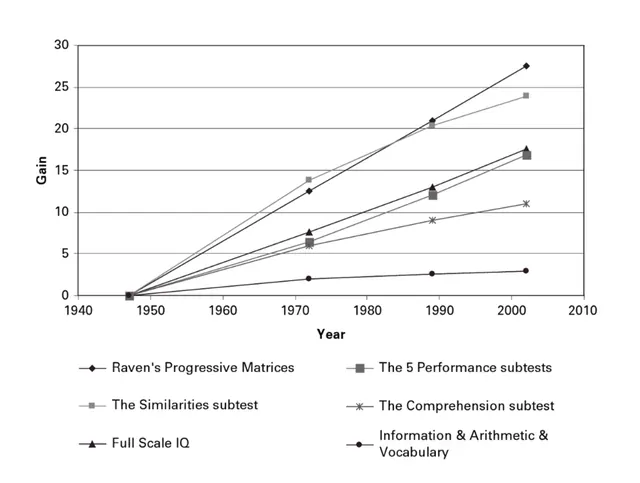
Raw IQ test scores climbed substantially and steadily across successive birth cohorts through the twentieth century, on the order of three points per decade, adding up to roughly thirty points over a century. Because IQ is scored relative to a population, the average fixed at one hundred, the underlying gains only show up when old and new norms are compared, and tests must be periodically re-normed to keep pace.
Rated Empirical: grounded in studies or measurable evidence. The other 608.
People did not become smarter in any everyday sense; average performance on the specific tasks IQ tests measure rose over time. Since the mean is pegged at one hundred for each standardisation sample, the raw-score gains become visible only when a test normed decades ago is given to people today, who then score well above the old average. The proposed causes: better schooling, greater test familiarity, improved nutrition, more cognitively demanding environments, reduced disease and lead exposure, smaller families — are many, and none is established as the cause.
The documented slowdown or decline in average scores in several developed countries since roughly the 1990s, reversing the long twentieth-century rise.
The uneven pattern in which gains are largest on fluid, abstract reasoning and smallest on crystallized knowledge like vocabulary: itself an argument against reading the effect as a simple rise in intelligence.
It is one of the most important and puzzling findings in psychometrics, forcing the recognition that IQ scores are relative to their era and cannot be compared across decades without re-norming. It complicates claims about intelligence, heredity, and group differences, and its recent reversal in rich countries deepens the puzzle of what environmental forces drive it.
The score gains and the resulting need to re-norm are well documented, but the cause is unknown and debated: no proposed mechanism is established. The effect does not mean genes changed, since the gains are far too rapid for that, nor straightforwardly that each generation is smarter, given the uneven fluid-versus-crystallized pattern. And it has stalled or reversed in several developed countries since around the 1990s; a large Norwegian study found the decline appears within families, ruling out genetic selection or immigration and pointing to environmental drivers for both the rise and the fall. Most data come from developed nations, limiting generalisation.
It does not show that people are becoming genetically smarter: the gains are too fast to be genetic and reflect changing environments. And it is not a permanent, universal climb: scores have plateaued or reversed in several rich countries in recent decades.
Yes, as far as the evidence goes. The Flynn Effect is rated Empirical here: it rests on studies or measurements rather than on a saying.
FORRT's Replication Database records 2 replication studies of this effect. It has not yet computed an outcome for any of them, so there is no pass or fail to report here, only that the work exists. FORRT Replication Database (FReD), Röseler et al., Journal of Open Psychology Data. CC BY 4.0.
Rated from two sources. 609 of the 1,116 entries carry this rating. How the scale works.
The best-known laws are the least likely to rest on measurement.
Documented and popularised by James Flynn in the 1980s, and named 'the Flynn effect' by Herrnstein and Murray in The Bell Curve (1994); rising scores had been noted earlier by Runquist, Smith, and Tuddenham, and the reversal was analysed by Bratsberg and Rogeberg in 2018.
9 languages, as recorded on Wikidata. These are names the idea already goes by, not translations we made. The whole index by language.
Everything above traces to en.wikipedia.org and pnas.org, two sources in all, one of them the original publication rather than an account of it. Nothing is written from memory, and the method is written down. Spot an error or a better source? Suggest a fix.
