The Friendship Paradox
"On average, your friends have more friends than you do."
In almost any social network, the average number of friends that people's friends have exceeds the average number of friends people have. Most individuals therefore come up short when they compare their own friend count to the typical count of the people they know, not from unpopularity, but from how the counting works.
Rated Empirical: grounded in studies or measurable evidence. The other 608.
It is a sampling bias, not a psychological effect. Highly connected people appear on many friend lists, so when you sample 'a friend' you over-select these hubs: each is counted once per friendship they hold, while a random person is counted once. Formally, the average number of friends of a random friend is the mean degree plus the variance over the mean, so whenever people differ in how many friends they have, friends-of-friends average strictly more.
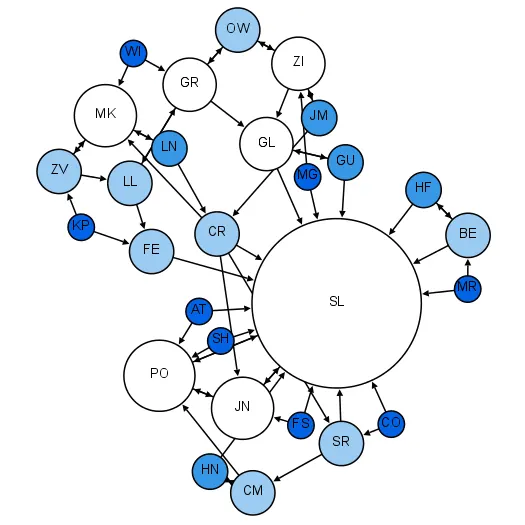
The same mathematical family: sampling something in proportion to its size over-represents the large values, whether friendships, waiting times, or class sizes.
The extension beyond friend count: your friends are also, on average, more of many correlated things than you (more co-authored, more cited, sometimes wealthier) for the same sampling reason.
It is a clean, proven example of how sampling bias produces a genuinely lopsided average from a symmetric relationship, and a caution against the social comparison that makes people feel inadequate against their friends. It has also been put to practical use, from epidemic sensors to vaccination strategies that target well-connected people.
It is a statement about averages, driven by the variance and skew of the degree distribution; it does not hold for every individual, and someone more connected than all their friends is a perfectly valid exception. The inequality is strict only when people's friend counts actually vary: in a perfectly regular network everyone averages the same. It is a real, proven result, not a fallacy or cognitive bias, though it is frequently misdescribed as applying to every person.
It does not mean you personally are less popular than all your friends. It is an aggregate driven by hubs being over-sampled, and individual exceptions abound. Nor is it a psychological illusion; it is a proven mathematical fact about how averages over a network work.
Yes, as far as the evidence goes. The Friendship Paradox is rated Empirical here: it rests on studies or measurements rather than on a saying.
Rated from two sources. 609 of the 1,116 entries carry this rating. How the scale works.
The best-known laws are the least likely to rest on measurement.
Identified by the sociologist Scott L. Feld in his 1991 paper 'Why Your Friends Have More Friends Than You Do' (American Journal of Sociology), which gave both the observation and the mathematical demonstration.
8 languages, as recorded on Wikidata. These are names the idea already goes by, not translations we made. The whole index by language.
Everything above traces to en.wikipedia.org and journals.plos.org, two sources in all, one of them the original publication rather than an account of it. Nothing is written from memory, and the method is written down. Spot an error or a better source? Suggest a fix.
