The Gaia Hypothesis
also known as — Gaia theory, Geophysiology
"Life and its environment form one self-regulating system that keeps the Earth fit for life."
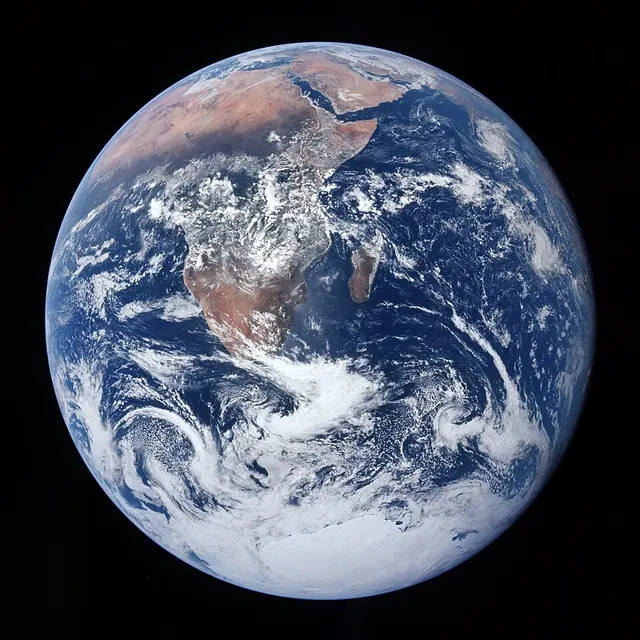
The Gaia hypothesis proposes that living organisms interact with their inorganic surroundings on Earth to form a synergistic, self-regulating, complex system that helps maintain and perpetuate the conditions for life on the planet. On this view, biological and physical processes are coupled through feedback loops that hold key planetary variables, global temperature, atmospheric composition, ocean salinity, within ranges tolerable for life. It ranges from a weak, widely accepted reading, that life significantly influences its environment, to a strong, rejected version in which the biosphere behaves almost purposefully.
Rated Contested: disputed, with the evidence still argued over. The other 256.
Life and environment are coupled by feedbacks, some stabilising and some not. James Lovelock's insight, developed with the microbiologist Lynn Margulis, was that Earth's atmosphere is biologically transformed and held far from chemical equilibrium by living processes. The credible, non-teleological mechanism is that ordinary natural selection and physics can produce planet-scale regulation without foresight. The Daisyworld model, by Lovelock and Andrew Watson, made this concrete: an imaginary planet of light and dark daisies, each simply maximising its own growth, passively regulates temperature as its star brightens, showing self-regulation can emerge from local competition alone.
A spectrum from influential and coevolutionary Gaia, that life shapes its environment, through homeostatic Gaia, that the coupling is stabilising, up to the optimising, teleological version that is widely rejected.
Peter Ward's explicit anti-Gaia, that multicellular life is ultimately self-destructive, offered as the named counterpoint to Gaian optimism.
Gaia was a major intellectual driver behind treating the Earth as a single coupled system rather than as separate geology, biology, atmosphere, and oceans, a framing that underlies modern Earth system science. It foregrounded how far life shapes global chemical cycles, and Lovelock's original insight, that a living planet betrays itself through atmospheric chemical disequilibrium, remains directly relevant to the search for biosignatures on exoplanets. Even scientists who reject strong Gaia credit it with provoking productive research into planetary feedbacks.
The strong, optimising version was heavily criticised by evolutionary biologists. W. Ford Doolittle argued nothing in any organism's genome could encode planet-wide feedback, and Richard Dawkins objected that global self-regulation would require organisms to act in concert with foresight, and that with no reproducing population of planets undergoing selection there is no way to build planetary-scale adaptation. These critiques target the teleological reading; a naturalistic, non-teleological Gaia is now influential in Earth system science while the purposive version is rejected. Some cited evidence, such as the CLAW cloud-feedback hypothesis, is itself contested and largely unsupported as originally stated.
It does not require the Earth to be a literally conscious or living organism; the living-planet language is a metaphor, and taken literally corresponds to the discredited strong version, which is why Lovelock preferred geophysiology. It is not New Age mysticism, despite the mythological name; the core naturalistic claim is a testable one about feedback and stability. And it does not claim the Earth optimises conditions for humans or maintains stability deliberately.
That is exactly what is in dispute. The Gaia Hypothesis is rated Contested here: the effect is claimed, the evidence is argued over, and specialists disagree.
Rated from two sources. 257 of the 1,116 entries carry this rating. How the scale works.
The best-known laws are the least likely to rest on measurement; the full verdict on The Gaia Hypothesis.
Nothing here is the formal negation of The Gaia Hypothesis — these are the entry in this index that pulls the other way, so that following both at once forces a choice.
Formulated by the scientist James Lovelock from the 1960s, the name suggested by the novelist William Golding, developed with the microbiologist Lynn Margulis, and set out in 'Gaia: A New Look at Life on Earth' (1979).
9 languages, as recorded on Wikidata. These are names the idea already goes by, not translations we made. The whole index by language.
Everything above traces to en.wikipedia.org and onlinelibrary.wiley.com, two sources in all, one of them the original publication rather than an account of it. Nothing is written from memory, and the method is written down. Spot an error or a better source? Suggest a fix.
