The Hairy Ball Theorem
also known as — The hedgehog theorem, You can't comb a hairy ball flat
"You cannot comb the hair on a ball flat without leaving at least one cowlick."
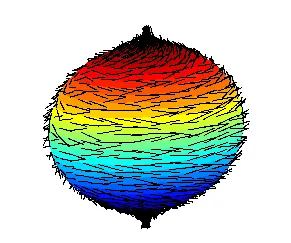
The hairy ball theorem states that there is no continuous field of nonzero tangent vectors on an even-dimensional sphere; on an ordinary sphere, any continuous assignment of a tangent arrow to each point must be zero somewhere. Picture a ball covered in hair: you cannot comb it so that every hair lies flat against the surface without creating at least one point where the hair stands up or swirls, a cowlick. The same is not true of a doughnut, whose hair can be combed flat all the way around. It is a theorem of topology, a vivid illustration that the shape of a surface forces the behaviour of any smooth flow across it, with the sphere's curvature leaving no way to avoid a singular point.
Rated Empirical: grounded in studies or measurable evidence. The other 608.
The obstruction is measured by a topological invariant called the Euler characteristic, and the Poincare-Hopf theorem ties it to vector fields: the sum of the indices of the zeros of any tangent vector field on a closed surface equals the surface's Euler characteristic. For the ordinary sphere that characteristic is two, which is not zero, so a nowhere-zero field is impossible; the field must have zeros whose indices sum to two, at least one cowlick. A torus, by contrast, has Euler characteristic zero, so its hair can be combed flat without any singular point. The theorem generalises to spheres of every even dimension, whose Euler characteristic is two, while odd-dimensional spheres admit nowhere-zero tangent fields.
The general result that the zeros of a vector field on a closed surface have indices summing to the Euler characteristic, of which the hairy ball theorem is the sphere case.
The extension to all even-dimensional spheres, which likewise admit no nowhere-zero tangent field, while every odd-dimensional sphere does admit one.
The hairy ball theorem is a memorable gateway to algebraic topology and the idea that global shape constrains local structure, linking the Euler characteristic to the unavoidable singularities of any continuous flow. It has concrete consequences, from the guaranteed existence of a windless point on Earth to constraints in physics on fields defined over spheres, and it is a favourite illustration of how topology delivers surprising certainties. Together with the Brouwer fixed-point theorem and the Poincare-Hopf theorem, it exemplifies how counting invariants force the existence of special points, a theme that runs through modern geometry and dynamical systems.
The theorem is specific to even-dimensional spheres and, more precisely, to surfaces whose Euler characteristic is nonzero; a torus, with characteristic zero, can be combed flat, so the result is not about roundness alone but about topology. Odd-dimensional spheres, like the circle or the three-sphere, admit nowhere-zero tangent fields and so escape the theorem. It requires the field to be tangent and continuous; a field allowed to point outward, or one with discontinuities, faces no such obstruction. And it guarantees a zero exists without saying how many there are beyond the index-sum constraint or where they lie.
The theorem is not about all shapes: a doughnut can be combed flat, so the impossibility is peculiar to the sphere and other even-dimensional spheres, driven by a nonzero Euler characteristic. It concerns tangent vector fields, so a field allowed to stick straight out of the surface is not what the theorem forbids. And the vanishing point need not be a single tidy bald spot; the theorem constrains the sum of the indices of the zeros to equal two, which could be realised by one swirl or several, not necessarily a lone point.
Yes, as far as the evidence goes. The Hairy Ball Theorem is rated Empirical here: it rests on studies or measurements rather than on a saying.
Rated from two sources. 609 of the 1,116 entries carry this rating. How the scale works.
The best-known laws are the least likely to rest on measurement.
Proved by L.E.J. Brouwer in 1912 for the ordinary sphere, following Henri Poincare's earlier work on singularities of vector fields, and subsumed by the Poincare-Hopf index theorem relating zeros to the Euler characteristic.
8 languages, as recorded on Wikidata. These are names the idea already goes by, not translations we made. The whole index by language.
Everything above traces to en.wikipedia.org and mathworld.wolfram.com: two secondary sources, accounts of the original rather than the original itself, which has not been located for this entry. Nothing is written from memory, and the method is written down. Spot an error or a better source? Suggest a fix.
