The Hill Equation
also known as — Hill-Langmuir equation
"Cooperative binding gives an S-shaped curve of how saturated a molecule is with its ligand."
 From the Librarian's card index. No source, no stamp.
"Cooperative binding gives an S-shaped curve of how saturated a molecule is with its ligand."
From the Librarian's card index. No source, no stamp.
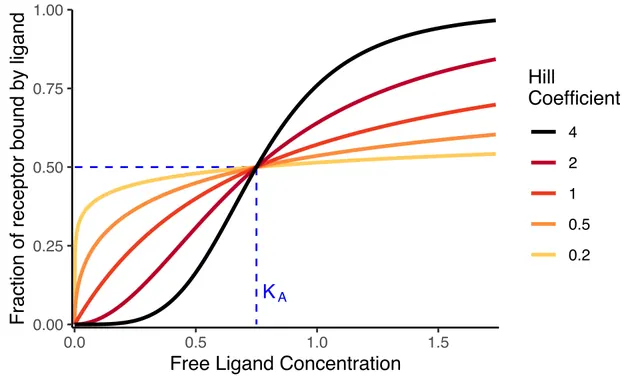
The Hill equation describes how the fraction of a large molecule saturated by a binding ligand rises with the ligand's concentration when binding is cooperative. Instead of the plain hyperbola of independent binding, cooperativity produces a sigmoidal, S-shaped curve. A single number, the Hill coefficient, captures the degree of cooperativity: greater than one for positive cooperativity, one for none, and less than one for negative cooperativity.
Rated Empirical: grounded in studies or measurable evidence. The other 608.
When binding is cooperative, the attachment of one ligand changes the molecule's affinity for the next. In positive cooperativity, each bound ligand makes further binding easier, so saturation stays low until a threshold concentration and then climbs steeply, tracing an S. The Hill coefficient indexes this interaction; at a value of one, binding is independent and the equation collapses to the simple hyperbola of the Michaelis-Menten form. The classic case is oxygen binding to hemoglobin's four subunits, where binding at one site raises affinity at the others, producing the sigmoidal oxygen-dissociation curve.
The Monod-Wyman-Changeux concerted model and the Koshland-Nemethy-Filmer sequential model, which give mechanistic accounts of cooperativity that the phenomenological Hill equation only fits.
The version written with the ligand concentration for half-maximal binding, which carries ordinary concentration units, clarifying the compressed constant in the compact form.
It is a foundational tool across biochemistry, pharmacology, and physiology, used to summarise cooperative binding in a single index and to fit dose-response and saturation curves. It underlies the understanding of hemoglobin's oxygen transport, the behaviour of allosteric enzymes, and drug potency, giving scientists a compact, comparable measure of how strongly binding at one site influences binding at others.
It is a phenomenological, empirical model that fits curves rather than describing the binding mechanism, as Hill himself stressed. The Hill coefficient does not equal the number of binding sites; hemoglobin has four sites but a coefficient below three, so it is an interaction index, not a site count. The coefficient is also condition-dependent. More mechanistic models such as the concerted and sequential accounts of cooperativity supersede the equation where the actual process matters.
The Hill coefficient is not the number of binding sites; hemoglobin has four sites yet a coefficient of roughly two to three, so it measures cooperativity, not count. The equation does not reveal the molecular mechanism; Hill explicitly disclaimed physical meaning for its parameters. And the compact constant in the denominator is not an ordinary dissociation constant, since it carries the exponent, which is why the half-saturation form is often preferred.
Yes, as far as the evidence goes. The Hill Equation is rated Empirical here: it rests on studies or measurements rather than on a saying.
Rated from two sources. 609 of the 1,116 entries carry this rating. How the scale works.
The best-known laws are the least likely to rest on measurement.
Derived by the physiologist Archibald Vivian Hill in 1910 from his study of oxygen binding to hemoglobin, and still used as a phenomenological description of cooperative binding.
Everything above traces to en.wikipedia.org and occamstypewriter.org: two secondary sources, accounts of the original rather than the original itself, which has not been located for this entry. Nothing is written from memory, and the method is written down. Spot an error or a better source? Suggest a fix.
