The Lambda Calculus
also known as — λ-calculus, Church's calculus
"Build all of computation out of nothing but functions that take arguments and are applied to them."
 From the Librarian's card index. No source, no stamp.
"Build all of computation out of nothing but functions that take arguments and are applied to them."
From the Librarian's card index. No source, no stamp.
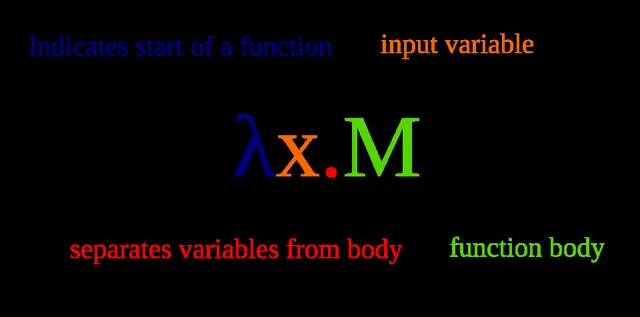
The lambda calculus is a formal system for expressing computation based entirely on function abstraction and application, using variable binding and substitution. In it, everything is a function. Terms are built from just three ingredients: variables; abstraction, written lambda x dot M, denoting a function of x with body M; and application, writing one term next to another to apply a function to an argument. Introduced by Alonzo Church in the 1930s, it is one of the two classical foundations of computability, equal in power to the Turing machine, and it is the theoretical basis of functional programming, type theory, and proof assistants.
Rated Empirical: grounded in studies or measurable evidence. The other 608.
Computation proceeds by beta-reduction, the heart of the calculus: applying a function to an argument substitutes the argument for the function's bound variable in its body. Alpha-conversion allows renaming bound variables, and care is taken so substitution does not accidentally capture free variables. Data can be encoded purely as functions, such as Church numerals, which represent a number by how many times they apply a function, and recursion is achieved with fixed-point combinators like the Y combinator. The untyped calculus is Turing-complete, equivalent to Turing machines and the recursive functions, while the simply typed version trades that universal power for guaranteed termination.
The untyped lambda calculus is Turing-complete, while the simply typed version is strongly normalising, so every well-typed term terminates and it is deliberately not Turing-complete.
The deep parallel in which propositions correspond to types and proofs to programs, linking logic and computation and underpinning proof assistants.
The lambda calculus is one of the two founding models of computation, and through the Church-Turing thesis it helped define what is computable. It is the theoretical bedrock of functional programming languages such as Lisp, ML, and Haskell, and of denotational semantics, type theory, and the proof assistants used to verify mathematics and software. The Curry-Howard correspondence it supports, identifying proofs with programs, is one of the deepest bridges between logic and computer science. Few formal systems so small have proved so fertile.
Beta-reduction is confluent, so a normal form is unique when it exists, but not every term has one: some terms reduce forever, so evaluation may not terminate. Naive substitution can accidentally capture free variables, which is why capture-avoiding substitution and alpha-conversion are needed. Turing-completeness belongs to the untyped calculus; adding simple types buys guaranteed termination at the cost of that universal power, an inherent trade-off, and richer type systems are needed to regain it. And the Church-Turing thesis, that the calculus captures the informal notion of effective computability, is a thesis, not a formally provable theorem.
The lambda calculus is not merely a programming language; it is a minimal formal system and model of computation that programming languages draw on but greatly extend. The simply typed lambda calculus is not Turing-complete, being deliberately strongly normalising; only the untyped version, or richer typed ones with recursion, has universal power. Church's lambda-calculus work of the 1930s predates and parallels Turing's machines rather than following them, and the two were proved equivalent. And Church numerals are functions that encode numbers by iteration, not numbers themselves.
Yes, as far as the evidence goes. The Lambda Calculus is rated Empirical here: it rests on studies or measurements rather than on a saying.
Rated from two sources. 609 of the 1,116 entries carry this rating. How the scale works.
The best-known laws are the least likely to rest on measurement.
Introduced by Alonzo Church in the early 1930s and used in his 1936 proof that the Entscheidungsproblem is undecidable; shown by Church, Turing, and Kleene to be equivalent in power to Turing machines and the recursive functions.
9 languages, as recorded on Wikidata. These are names the idea already goes by, not translations we made. The whole index by language.
Everything above traces to plato.stanford.edu and en.wikipedia.org: two secondary sources, accounts of the original rather than the original itself, which has not been located for this entry. Nothing is written from memory, and the method is written down. Spot an error or a better source? Suggest a fix.
