The Photoelectric Effect
"Light ejects electrons only above a threshold frequency, however bright it is."
 From the Librarian's card index. No source, no stamp.
"Light ejects electrons only above a threshold frequency, however bright it is."
From the Librarian's card index. No source, no stamp.
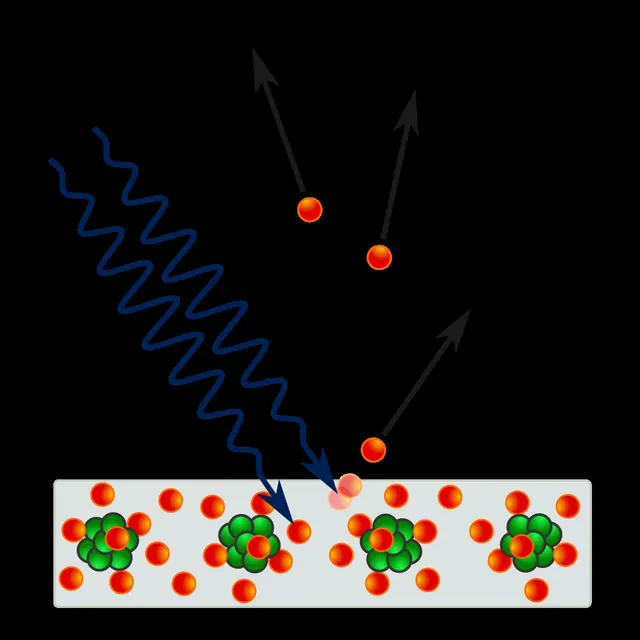
When light strikes a material, it can knock electrons out of the surface, but only if the light's frequency exceeds a threshold set by the material. Below that frequency, no electrons come out no matter how intense or how prolonged the light. Above it, emission is immediate, and the energy of the ejected electrons depends on the light's frequency, not its brightness; brightness controls only how many electrons emerge. These facts defeated classical wave theory and were the first strong evidence that light comes in quanta.
Rated Empirical: grounded in studies or measurable evidence. The other 608.
Einstein proposed that light energy arrives in discrete quanta, later called photons, each carrying an energy equal to Planck's constant times the frequency. In the effect, one photon gives all its energy to one electron. If that energy exceeds the work function, the minimum needed to free an electron from the surface, the electron escapes with the surplus as kinetic energy, so the maximum kinetic energy equals the photon energy minus the work function. Because energy comes in indivisible lumps, a below-threshold photon can never be pieced together with others to free an electron, which is why the frequency threshold is sharp and the response instantaneous.
The related but distinct process behind solar cells, where absorbed photons lift electrons across a semiconductor's band gap and a junction builds a voltage, without ejecting electrons from a surface into vacuum.
At the enormous intensities of pulsed lasers an electron can absorb two or more photons at once, escaping even when each single photon falls below the threshold: a departure from the simple one-photon picture.
It was pivotal evidence for the quantum nature of light and a turning point in the birth of quantum theory; Einstein's explanation of it, not his relativity, is what his Nobel Prize named. Beyond history, it underlies photodetectors, spectroscopy, and imaging, and it remains the textbook demonstration that energy at the atomic scale is exchanged in discrete quanta.
Einstein's simple equation and the sharp threshold describe the regime of one photon per electron, valid when the intensity is not too high; at laser intensities multiphoton absorption breaks the threshold picture. The work function depends on the material and is sensitive to surface condition, so oxide layers, contamination, and crystal face all shift it: a persistent source of experimental scatter. And the effect is popularly overcredited as proof that light is quantised: semiclassical theories that quantise the electron while treating the field as a classical wave can reproduce its main features, and the decisive evidence for photons comes instead from photon-correlation experiments.
Brighter light does not give the electrons more energy: it gives more electrons, each with the same maximum energy; only higher frequency raises that energy. And Einstein won his Nobel Prize for explaining this effect, not for relativity. The claim that the effect proves the photon is overstated: it motivated the idea powerfully but is not by itself airtight.
Yes, as far as the evidence goes. The Photoelectric Effect is rated Empirical here: it rests on studies or measurements rather than on a saying.
Rated from four sources. 609 of the 1,116 entries carry this rating. How the scale works.
The best-known laws are the least likely to rest on measurement.
First noticed by Heinrich Hertz in 1887 and studied quantitatively by Philipp Lenard; explained by Albert Einstein in 1905 with the light-quantum hypothesis and the equation relating electron energy to frequency, confirmed by Robert Millikan around 1916, and recognised by the Nobel Prize designated for 1921.
10 languages, as recorded on Wikidata. These are names the idea already goes by, not translations we made. The whole index by language.
Everything above traces to the four sources listed, one of them the original publication rather than an account of it. Nothing is written from memory, and the method is written down. Spot an error or a better source? Suggest a fix.
