The Prisoner's Dilemma
"Two rational players, each better off betraying, both betray and end up worse than if they had cooperated."
"Two rational players, each better off betraying, both betray and end up worse than if they had cooperated."
Two self-interested players each choose to cooperate or defect. For each, defecting yields a higher payoff whatever the other does, so defection is a dominant strategy, and since both reason the same way, both defect and each ends up worse off than if both had cooperated. The dilemma is that individually rational choices produce a collectively worse outcome.
Rated Empirical: grounded in studies or measurable evidence. The other 608.
The payoffs are ordered so that betraying a cooperator is best, mutual cooperation is next, mutual defection is worse, and being the betrayed cooperator is worst. Because betraying beats cooperating both when the other cooperates and when the other defects, defection strictly dominates. Mutual defection is therefore the unique Nash equilibrium, from which neither can improve alone, yet mutual cooperation would have paid both more. That gap between the equilibrium and the better joint outcome is the whole point.
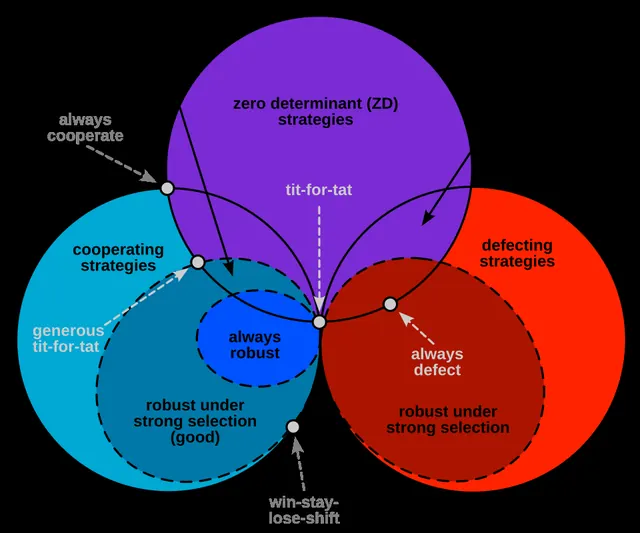
The game repeated over many rounds, where the prospect of future encounters can sustain cooperation through strategies like tit-for-tat, unlike the one-shot game.
The multi-player generalisation, in which many users each rationally overuse a shared resource and collectively deplete it.
It is the most famous model in game theory, capturing in a single structure why rational self-interest can defeat mutual benefit: from arms races and price wars to pollution and doping. It launched the formal study of cooperation and remains the reference point for understanding when and how self-interested parties fail, or manage, to work together.
The stark result applies to the one-shot game: in a single encounter with no communication or future, mutual defection is the unavoidable rational outcome. In repeated play with an uncertain end, cooperation can emerge and stabilise through reciprocity. Real people, including the earliest experimental subjects, cooperate substantially more than pure rational-choice theory predicts, even in one-shot settings. The model also assumes purely self-interested, rational players with common knowledge of payoffs that genuinely satisfy its ordering: where those fail, the predictions change, and the label is often applied loosely to cases that do not meet the formal conditions.
It does not show that cooperation is always irrational: in the repeated game, reciprocity makes cooperation an equilibrium; the bleak result is specific to the one-shot version. And not every thwarted-cooperation situation is a true prisoner's dilemma; the label requires the specific payoff ordering.
Yes, as far as the evidence goes. The Prisoner's Dilemma is rated Empirical here: it rests on studies or measurements rather than on a saying.
Rated from two sources. 609 of the 1,116 entries carry this rating. How the scale works.
The best-known laws are the least likely to rest on measurement.
Nothing here is the formal negation of The Prisoner's Dilemma — these are the entries in this index that pull the other way, so that following both at once forces a choice.
Devised by Merrill Flood and Melvin Dresher at the RAND Corporation in 1950; the prison-sentence story and the name came from Albert Tucker later that year, though the phrase first appears in print in Luce and Raiffa's 1957 text.
10 languages, as recorded on Wikidata. These are names the idea already goes by, not translations we made. The whole index by language.
Everything above traces to plato.stanford.edu and en.wikipedia.org: two secondary sources, accounts of the original rather than the original itself, which has not been located for this entry. Nothing is written from memory, and the method is written down. Spot an error or a better source? Suggest a fix.
