The Riemann Hypothesis
also known as — RH, The Riemann zeta conjecture
"Every nontrivial zero of the Riemann zeta function lies exactly on the critical line, half."
"Every nontrivial zero of the Riemann zeta function lies exactly on the critical line, half."
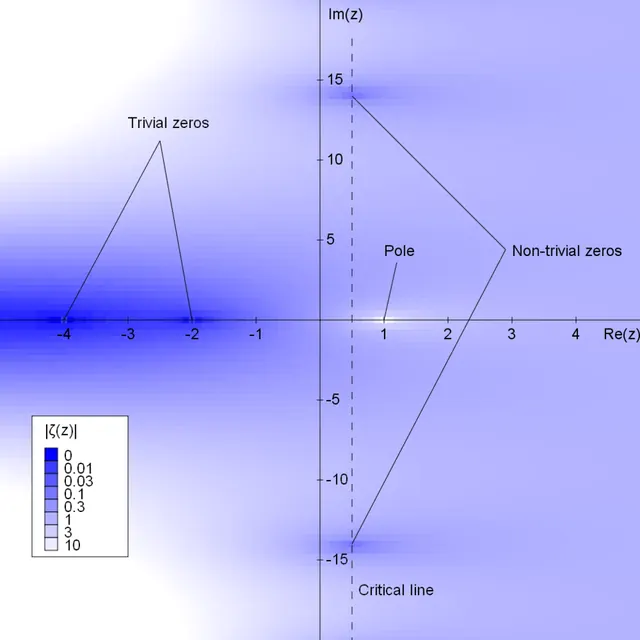
The Riemann hypothesis conjectures that all the nontrivial zeros of the Riemann zeta function have real part equal to one half, lying on a single vertical line in the complex plane called the critical line. The zeta function encodes the distribution of the prime numbers, and the location of its zeros controls how regularly the primes are spaced. Proposed by Bernhard Riemann in 1859, the hypothesis is the most famous unsolved problem in mathematics, one of Hilbert's twenty-three problems and one of the seven Clay Millennium Prize Problems carrying a million-dollar reward. It remains unproven, yet an enormous body of number theory is built on the assumption that it is true.
Rated Contested: disputed, with the evidence still argued over. The other 256.
The link between the zeta function and the primes runs through Euler's product formula, which expresses the zeta function as a product over all primes, so its analytic behaviour carries arithmetic information. The prime number theorem, describing the average density of primes, is equivalent to the zeta function having no zeros on the line where the real part is one; the Riemann hypothesis is a far sharper claim, that all the nontrivial zeros sit on the line where the real part is exactly one half. If true, it would pin down the error term in the prime counting function to the smallest possible size, meaning the primes are distributed as regularly as they possibly could be, with the zeros acting like frequencies in a hidden harmony of the primes.
An extension to Dirichlet L-functions and other zeta-like functions, whose truth would settle many further questions in analytic number theory.
The conjecture that the zeros correspond to eigenvalues of some self-adjoint operator, a proposed physical route to a proof connecting the primes to quantum chaos.
The Riemann hypothesis stands at the centre of number theory because the location of the zeta zeros governs the finest structure of the prime numbers, and hundreds of published theorems begin conditionally with if the Riemann hypothesis is true. A proof would sharpen the prime number theorem to its limit, secure results in cryptography and computation that depend on prime distribution, and likely open deep connections between number theory, analysis, and mathematical physics. Unsolved for over a century and a half, it is a benchmark of mathematical difficulty and, through its Clay Millennium status, the most celebrated open problem in the subject.
The hypothesis is unproven, so results resting on it remain conditional, however strong the numerical and partial evidence. Verifying trillions of zeros on the critical line does not constitute a proof, since infinitely many remain unchecked and a single off-line zero would refute it. Hardy's theorem gives infinitely many zeros on the line but not that all of them lie there, and the analogous statement for function fields, proved by Weil and Deligne, does not carry over to the classical case. The problem's difficulty is that no known method reaches all the zeros at once, and even a proof might illuminate the primes without yielding easy new computations.
The hypothesis concerns only the nontrivial zeros; the zeta function also has trivial zeros at the negative even integers, which are known and not at issue. Checking enormous numbers of zeros by computer confirms but does not prove it, because the claim is about all infinitely many nontrivial zeros. And it is not the same as the prime number theorem, which is proved: the prime number theorem corresponds to there being no zeros on the line where the real part is one, while the Riemann hypothesis makes the far stronger, still-open claim that they all lie on the line one half.
That is exactly what is in dispute. The Riemann Hypothesis is rated Contested here: the effect is claimed, the evidence is argued over, and specialists disagree.
Rated from two sources. 257 of the 1,116 entries carry this rating. How the scale works.
The best-known laws are the least likely to rest on measurement.
Formulated by Bernhard Riemann in his 1859 paper on the number of primes below a given magnitude, listed as the eighth of Hilbert's problems in 1900 and as one of the Clay Mathematics Institute's seven Millennium Prize Problems in 2000, and unproven to this day.
10 languages, as recorded on Wikidata. These are names the idea already goes by, not translations we made. The whole index by language.
Everything above traces to en.wikipedia.org and claymath.org, two sources in all, one of them the original publication rather than an account of it. Nothing is written from memory, and the method is written down. Spot an error or a better source? Suggest a fix.
