The Virial Theorem
also known as — Clausius's virial theorem, The 2T + V rule
"In a stable, gravitationally bound system, the average kinetic energy is exactly half the magnitude of the potential energy."
The virial theorem relates, for a stable bound system averaged over time, its total kinetic energy to its total potential energy. For the inverse-square forces of gravity and electrostatics, twice the average kinetic energy plus the average potential energy equals zero, so the average kinetic energy is exactly half the magnitude of the potential energy, and the total energy equals minus the kinetic energy. This lets one relate motion to binding without ever solving the equations of motion, which is why it is a workhorse across astrophysics, plasma physics, and even quantum mechanics, and why it delivered the first hint that most of the universe's mass is unseen.
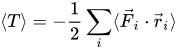
\langle T\rangle = -\frac12\sum_i \langle \vec F_i \cdot\vec r_i\rangleRated Empirical: grounded in studies or measurable evidence. The other 608.
In its general form, twice the average kinetic energy equals minus the average of each particle's force dotted with its position, a quantity Clausius named the virial. For a potential that varies as a power of distance, this specialises to twice the average kinetic energy equalling that power times the average potential energy; for gravity, where the power is minus one, it gives the familiar two-times-kinetic-plus-potential-equals-zero. The result holds only as a long-time or ensemble average of a bound, stable system whose particles stay in a finite region with bounded speeds, not as an instantaneous identity.
For a potential varying as distance to the power n, twice the average kinetic energy equals n times the average potential energy, giving equipartition of kinetic and potential energy for a harmonic force and the gravitational relation for an inverse-square one.
The same relation holds for quantum expectation values, so for the Coulomb potential of an atom twice the average kinetic energy equals minus the average potential energy.
The virial theorem is a remarkably powerful shortcut, relating the kinetic and potential energy of a bound system from time averages alone, without solving its dynamics. In astrophysics it is the standard way to weigh galaxies and galaxy clusters from their velocity dispersions, and it delivered Zwicky's landmark 1933 inference of dark matter. It explains the counterintuitive negative heat capacity of self-gravitating systems, central to how stars form and evolve, and it reaches into plasma physics, molecular dynamics, and quantum mechanics, making it one of the most broadly useful relations in all of physics.
The theorem holds only for a bound, stable system averaged over time, with motion confined to a finite region and bounded speeds; it is not an instantaneous identity, and it assumes the system is relaxed, or virialised. For merging, unrelaxed, or non-equilibrium clusters that assumption fails, biasing virial mass estimates. The clean gravitational relation, twice kinetic plus potential equals zero, is specific to inverse-square forces, and for other potentials the correct statement uses the power-law form, twice the kinetic energy equals the exponent times the potential energy.
The relation is a time or ensemble average, not an instantaneous one; it does not hold at every moment. The neat two-times-kinetic-plus-potential-equals-zero form applies only to inverse-square forces, and the general rule for a power-law potential uses its exponent instead. A virial, dynamical mass is not the visible mass; the whole force of Zwicky's result is that they differ. And a system must actually be virialised for the theorem to apply, so an unrelaxed cluster can violate its premise.
Yes, as far as the evidence goes. The Virial Theorem is rated Empirical here: it rests on studies or measurements rather than on a saying.
Rated from two sources. 609 of the 1,116 entries carry this rating. How the scale works.
The best-known laws are the least likely to rest on measurement.
Established by Rudolf Clausius in 1870, who coined the term virial from the Latin for force, and famously applied to galaxy clusters by Fritz Zwicky in 1933 to infer dark matter.
9 languages, as recorded on Wikidata. These are names the idea already goes by, not translations we made. The whole index by language.
Everything above traces to en.wikipedia.org and encyclopediaofmath.org: two secondary sources, accounts of the original rather than the original itself, which has not been located for this entry. Nothing is written from memory, and the method is written down. Spot an error or a better source? Suggest a fix.